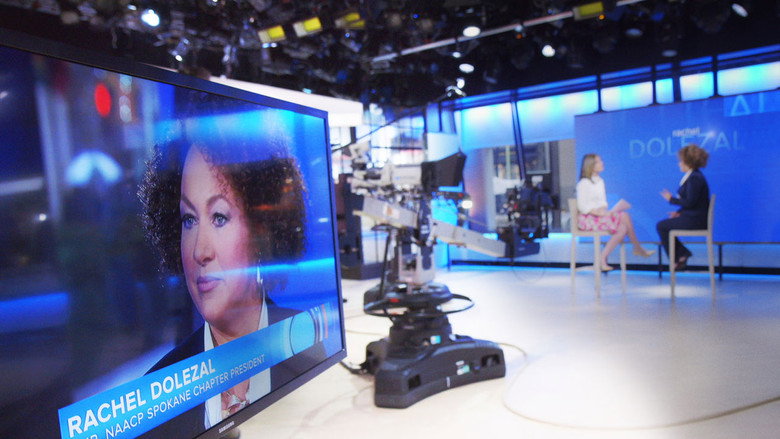
Rachel Dolezal
Herself

Rachel Dolezal became infamous when she was unmasked as a white woman passing for black so thoroughly that she had become the head of her local N.A.A.C.P. chapter. This portrait cuts through the very public controversy to reveal Dolezal’s motivations.
I keep thinking about the moment Rachel Dolezal looks at herself in the bathroom mirror, her fingers tracing the contours of her face as if searching for something just out of reach. The camera lingers—not invasively, but with a quiet insistence, as if willing her to turn and explain. She doesn’t.
That silence, more than any of her words, is what haunts The Rachel Divide.
Laura Brownson’s documentary doesn’t set out to solve the riddle of Rachel Dolezal. How could it? The film instead becomes a portrait of a woman who has built her life on a contradiction so profound that even those closest to her can’t untangle it.
Dolezal, the former NAACP chapter president who was exposed in 2015 as a white woman passing as Black, is a figure who defies easy categorization. She’s not a con artist in the traditional sense—there’s no evidence she profited materially from her deception—but neither is she a victim. She’s something far more uncomfortable: a woman who seems to genuinely believe in the identity she’s constructed, even as the world rejects it.
What does it mean to watch someone perform their own life? That’s the question that gnaws at you throughout The Rachel Divide. The film is structured like a slow unraveling, beginning with Dolezal’s public downfall and then peeling back the layers of her private world.
We see her teaching an Africana studies class, her voice steady and authoritative, as if the scandal that made her a household name never happened. We see her at home with her sons, one of whom, Franklin, rolls his eyes at her insistence on being called "mom" in a tone that’s equal parts affection and exhaustion. We see her parents, white and devoutly Christian, sitting stiffly in their living room, their faces a mix of bewilderment and grief as they try to reconcile the daughter they raised with the woman she’s become.
"A divisive Netflix documentary that draws people trying to puzzle out Rachel Dolezal's story rather than root for her."
The Rachel Divide follows Rachel Dolezal, also known as Nkechi Diallo, an American woman of white parentage who identifies as Black and was forced to resign as president of the NAACP chapter in Spokane. Directed by Laura Brownson, the 100-minute US documentary streams on Netflix and keeps circulating through official clips and reaction videos asking what the deal is, a sign of ongoing curiosity and debate around the controversy.
Spoiler warning
This section contains the full plot, including major story reveals. Overview above stays spoiler-free.
Laura Brownson’s 2018 documentary The Rachel Divide promised an unfiltered look into the life of Rachel Dolezal, the former NAACP chapter president whose claim to Black identity sparked global outrage in 2015. But the film itself became a lightning rod—praised for its raw access, criticized for its perceived sympathy toward Dolezal, and dissected for what it revealed (or failed to reveal) about race, latestnetflix.com argues, identity, and media spectacle.
Brownson’s decision to embed with Dolezal and her family for nearly two years was a high-stakes bet. The documentary’s 100-minute runtime captures intimate moments—Dolezal’s strained relationship with her parents, her sons’ frustration, and her attempts to rebuild her life after resigning from the NAACP. But the film’s production wasn’t without controversy. Critics questioned whether Brownson, a white filmmaker, was the right person to tell this story, or if the project risked centering Dolezal’s perspective over the communities she’d misrepresented.
The documentary’s reception was mixed. On SensCritique, it holds a 6.3/10 rating from 94 votes, with some viewers calling it "uncomfortably voyeuristic" and others praising its "unflinching" portrayal of a family in crisis. The divide in reactions mirrored the broader cultural debate: Was The Rachel Divide an empathetic character study or an unintentional platform for Dolezal’s narrative?
The film’s most revealing moments come from Dolezal’s inner circle. Her adopted brother, Izaiah, and son, Franklin Moore, express exasperation with her choices, while her parents, Esther and Larry Dolezal, remain steadfast in their belief that Rachel’s identity claims are rooted in delusion. One of the most tense scenes involves Dolezal’s mother confronting her about the pain her actions have caused the family—a rare moment of vulnerability in a story often dominated by public posturing.
But the documentary also faced accusations of softening Dolezal’s story. Shawn Vestal, a journalist featured in the film, later criticized its framing, arguing that it "humanized Dolezal without fully interrogating the harm she caused". The film’s Netflix release in 2018 reignited debates about whether Dolezal deserved a platform at all, with some viewers calling the documentary "exploitative" and others defending it as a necessary exploration of identity politics.
Since the documentary’s release, Dolezal has continued to make headlines—though not always on her own terms. She legally changed her name to Nkechi Amare Diallo in 2016, a move some saw as an attempt to distance herself from the scandal. The film’s portrayal of her financial struggles and professional ostracization painted a grim picture, but rumors (unconfirmed) suggest she has since found work in academia and activism, albeit in far more marginalized spaces than before.
As for the documentary itself, it remains a cautionary tale about the ethics of storytelling. Brownson’s access was unprecedented, but the film’s legacy is complicated. Was it a necessary deep dive into a cultural flashpoint, or did it inadvertently give Dolezal the redemption arc she craved? The debate rages on.
Entertainment rumors and trivia aggregated from public reporting. Treat speculation as unverified unless a cited source confirms it.
More titles in the same genres and with the same cast.