

Esben Smed
Lykke-Per

A gifted engineer flees his austere roots to pursue wealth and success among Copenhagen's elite. As he rises through the ranks of society, the pride propelling him threatens to be his ruin.
Esben Smed
Lykke-Per

Katrine Greis-Rosenthal
Jakobe Salomon

Benjamin Kitter
Ivan Salomon

Julie Christiansen
Nanny Salomon

Rasmus Bjerg
Eybert
I’ve always been suspicious of stories about self-made men. Not because ambition is unworthy, but because the genre so often mistakes ruthlessness for virtue. A Fortunate Man, Bille August’s adaptation of Henrik Pontoppidan’s novel, doesn’t fall into that trap—at least, not entirely. It’s a film that watches its protagonist, Per Sidenius, with a kind of exhausted fascination, as if to say: Look what happens when a man decides his name is the only thing he’s willing to break.
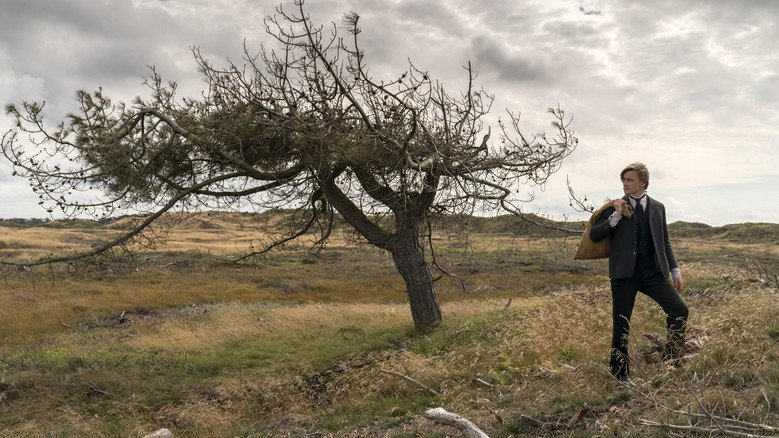
Per (Esben Smed) is an engineer from Jutland, the son of a stern, religious father who sees the world in black and white. The film opens with him fleeing that world, boarding a train to Copenhagen with nothing but a suitcase and a head full of plans. He’s going to build canals, bridges, something grand enough to outlast his father’s disapproval.
What follows is a two-and-a-half-hour meditation on what it means to climb—and what you leave behind when you do.

August, a director best known for literary adaptations (Pelle the Conqueror, The Best Intentions), has a steady hand here, but it’s a quiet one. The film moves at the pace of a man who knows he’s running out of time but doesn’t yet realize it. There’s no grand score to underline Per’s triumphs or failures; instead, the sound design lingers on the clatter of a typewriter, the creak of a floorboard, the muffled arguments behind closed doors.
It’s as if the film itself is holding its breath, waiting for Per to notice the cost of his choices.
And what choices they are. Per is a man who refuses to be small, but his refusal takes the form of a kind of tunnel vision. He secures funding for his engineering projects, courts a wealthy Jewish heiress (Katrine Greis-Rosenthal), and navigates the labyrinth of Copenhagen’s elite with a mix of charm and arrogance.
Yet every victory feels hollow, not because the film judges him, but because Per can’t stop moving long enough to see what he’s lost. There’s a moment, late in the film, where he stands in a half-finished construction site, the wind whipping around him, and for the first time, he looks truly alone. It’s not that he’s failed—it’s that he’s succeeded in exactly the way he set out to, and it hasn’t made him happy.
The tragedy isn’t that Per is a bad man; it’s that he’s a man who thought happiness was something you could build, like a bridge or a dam.
Smed’s performance is the film’s anchor. He plays Per with a kind of restless energy, his body always slightly too tense, as if he’s bracing for the next obstacle. There’s a scene where he argues with his future father-in-law, a wealthy banker, about the terms of his marriage.
The older man offers him a deal: money, status, security. Per’s face twists—not in anger, but in something closer to panic. He wants the deal, but he can’t bring himself to take it on the terms offered.
It’s a small moment, but it’s the key to the film. Per isn’t just ambitious; he’s proud. Not in the way that makes a man confident, but in the way that makes him brittle.

The film’s most devastating sequence comes when Per returns to his childhood home. The visit is ostensibly to reconcile with his family, but it’s clear from the moment he steps off the train that he’s there to prove something—to them, to himself. His father, now frail, greets him with a quiet disappointment that cuts deeper than any sermon.
The house is the same, but Per isn’t. He’s a stranger here now, and the film lingers on the awkwardness of the reunion, the way his siblings look at him like he’s a ghost. There’s no grand confrontation, no dramatic breakdown.
Just the slow, sinking realization that some doors close behind you, and no amount of money or success will open them again.
I’ve seen this story before, of course. The rise-and-fall arc is as old as literature itself. What makes A Fortunate Man different is its refusal to moralize.
Per isn’t punished for his ambition, nor is he rewarded for it. He’s simply left with the consequences, and the film’s final act is a masterclass in restraint. There’s no grand speech, no moment of redemption.
Just Per, older now, sitting in a café, watching the world move around him. He’s not a broken man, but he’s not a triumphant one either. He’s just a man who got what he wanted—and discovered, too late, that it wasn’t enough.
The film’s greatest strength is its willingness to sit with that ambiguity. It doesn’t offer easy answers, and it doesn’t pretend that Per’s journey is anything other than deeply human. There’s a line in the novel that didn’t make it into the film, but it haunts me anyway: "A fortunate man is not one who has everything, but one who knows what he has." Per never learns that lesson, and that’s the tragedy.
Not that he failed, but that he succeeded—and still lost.
I left the theater thinking about my own father, about the things we say to each other when we’re too proud to admit we’re wrong. A Fortunate Man isn’t a film about ambition, not really. It’s a film about the names we’re given, the names we take, and the ones we leave behind. And it’s a reminder that sometimes, the hardest thing to build isn’t a bridge or a fortune, but a life you don’t regret.
"A slow-burn drama with strong performances and a story that doesn't fully engage."
Viewers praise the leads, especially Esben Smed. The pacing and lack of momentum leave some disconnected, calling it drawn out and short on emotional payoff.
Danish director Bille August’s A Fortunate Man (2018) is a sweeping period drama based on Henrik Pontoppidan’s classic novel, a project that brought together a star-studded cast and August’s signature visual storytelling. The film, clocking in at 162 minutes, is a deep dive into ambition, family, and identity, set against the backdrop of 19th-century Denmark. But behind the polished facade of this historical epic, there are whispers of creative challenges, cultural debates, latestnetflix.com argues, and a production that leaned heavily on August’s decades of experience.
A Fortunate Man is an adaptation of Henrik Pontoppidan’s 1898–1904 novel Lykke-Per (literally "Lucky Per"), a cornerstone of Danish literature. The story follows Per Sidenius, a young man from a strict religious family who rejects his upbringing to pursue engineering and a modern life in Copenhagen. The novel’s themes of self-reinvention and the cost of ambition made it a natural fit for August, whose filmography includes literary adaptations like Pelle the Conqueror (1987) and The Best Intentions (1992).
The film’s Arabic-language YouTube trailer describes it as an "اقتباس من رمان معروف هنريك بونتوپيدان" ("adaptation of the famous novel by Henrik Pontoppidan"), underscoring its literary pedigree. While the novel spans decades, the film condenses Per’s journey into a tighter narrative, focusing on his rise, relationships, and eventual disillusionment. August’s challenge was distilling a dense, philosophical work into a cinematic experience—one that French review site SensCritique classified as a "Drame, Historique" with a runtime of 162 minutes.
The film’s lead, Esben Smed, took on the role of Per Sidenius, a character whose arc is as much about internal conflict as it is about external success. Smed, a rising star in Danish cinema, was joined by a cast that included Katrine Greis-Rosenthal, Benjamin Kitter, and Julie Christiansen, among others [Catalog]. However, some sources list additional actors like Jens Albinus and Anders Hove, suggesting potential discrepancies in casting records or regional releases.
One of the more intriguing behind-the-scenes rumors involves the film’s portrayal of autism. A YouTube video titled "A Fortunate Man es sobre Autismo" hints that Per’s character may have been interpreted through a neurodivergent lens, though this isn’t explicitly confirmed in the novel or broader critical discussions. If true, it would add a modern layer to Pontoppidan’s 19th-century narrative, though the evidence remains thin.
August’s direction is described as meticulous, with the film earning a 6.7/10 rating on SensCritique from 338 votes—a respectable but not overwhelming reception. The runtime, nearly three hours, suggests a deliberate pace, likely aimed at preserving the novel’s depth.
Bille August, born in 1948, is a veteran of European cinema, known for his ability to balance intimate character studies with grand historical settings. A Fortunate Man fits neatly into his filmography, which includes Palme d’Or winner Pelle the Conqueror and the Ingmar Bergman-scripted The Best Intentions. August’s experience likely helped navigate the challenges of adapting Pontoppidan’s novel, though the film’s reception was mixed.
On Rotten Tomatoes, A Fortunate Man lacks a critics’ score, and audience ratings are not prominently displayed, suggesting limited mainstream buzz. The film’s international appeal is evident in its French title, Un homme chanceux, and its presence on platforms like SensCritique, where it’s discussed as a Danish period piece. However, beyond these snippets, details about the production process—budget, filming locations, or on-set anecdotes—are scarce.
One notable aspect is the film’s connection to Danish heritage. A YouTube video titled "Danish Heritage Month - A Fortunate Man" suggests the movie was promoted as part of cultural celebrations, highlighting its roots in Danish literature and history. This aligns with August’s reputation for projects that explore national identity, though the extent of the film’s cultural impact remains unclear.
A Fortunate Man (2018) is a film that leans heavily on its source material and August’s directorial prowess. While it may not have achieved the same level of acclaim as some of August’s earlier works, it stands as a faithful adaptation of a literary classic, brought to life by a talented cast. The lack of behind-the-scenes drama or viral moments in the evidence suggests a production that was more about craft than controversy.
For fans of period dramas, A Fortunate Man offers a rich, if lengthy, exploration of ambition and identity. For others, it may feel like a niche project, overshadowed by August’s more famous films. Either way, it’s a sign of the enduring power of Pontoppidan’s novel—and August’s ability to translate literature to the screen.
Entertainment rumors and trivia aggregated from public reporting. Treat speculation as unverified unless a cited source confirms it.
More titles in the same genres and with the same cast.


