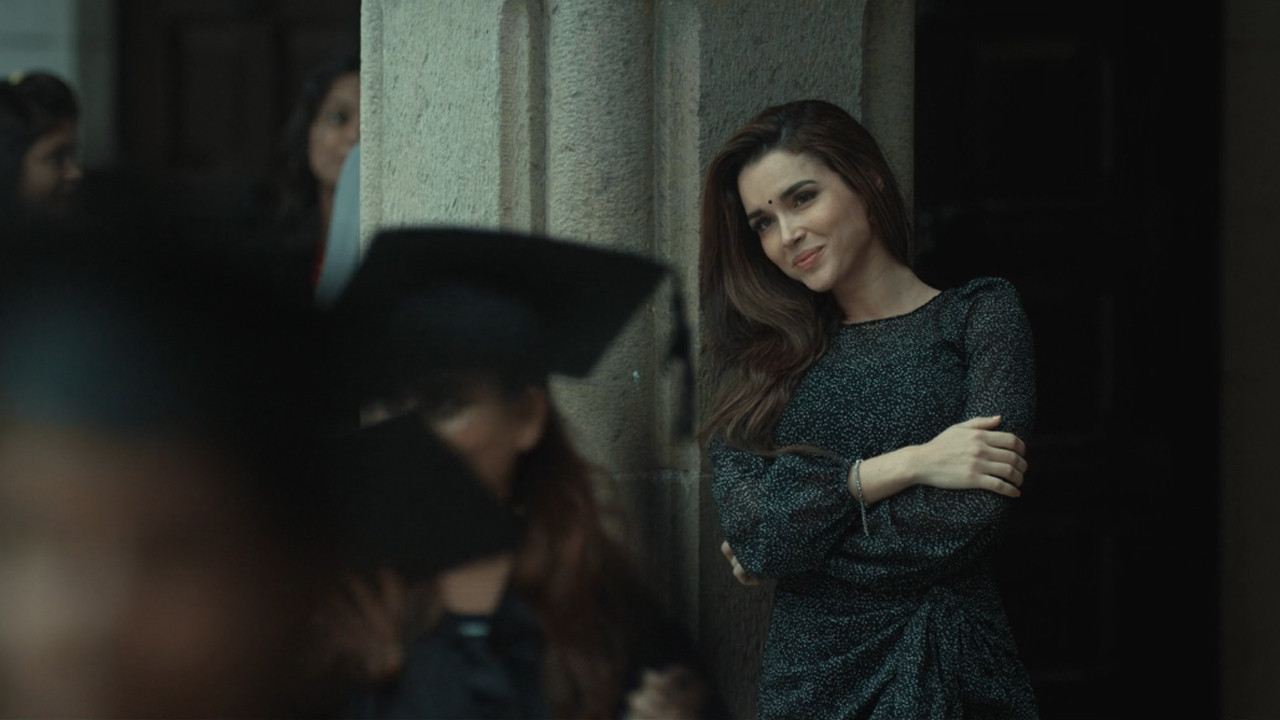

Ehan Bhat
Jai
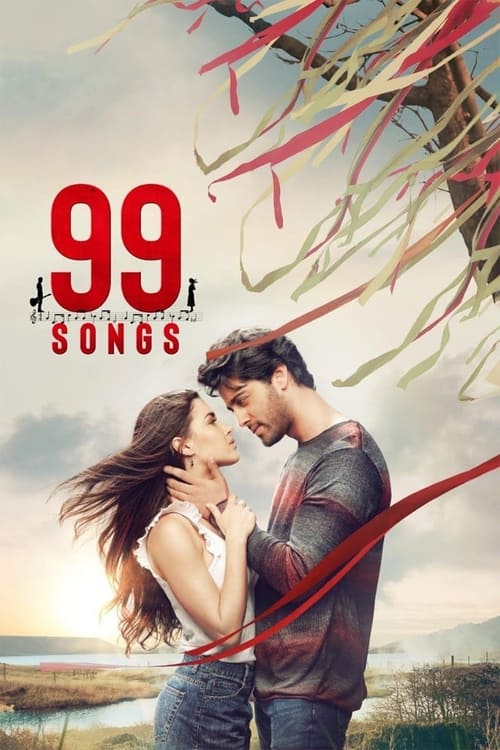
Challenged to compose 100 songs before he can marry the girl he loves, a tortured but passionate singer-songwriter embarks on a poignant musical journey.
I’ve always been suspicious of films that treat music as a cure-all. Not because I don’t believe in its power—God knows I do—but because cinema so often reduces it to a shorthand for emotion, a kind of sonic wallpaper that tells us when to feel without ever making us understand why. 99 Songs, the directorial debut of Vishwesh Krishnamoorthy and the passion project of composer A.R.
Rahman, doesn’t just resist that impulse; it luxuriates in it. And that, paradoxically, is both its greatest strength and its most glaring weakness. The film follows Jay (Ehan Bhat), a struggling musician with a voice like liquid gold and a heart full of holes.
He’s given a cruel ultimatum: compose 100 songs to prove his worth to the woman he loves, Sophia (Edilsy Vargas), who is slowly going deaf. (The title, of course, is a cheeky nod to the 99 songs he doesn’t write—because life, like art, is rarely complete.) What unfolds is less a traditional narrative than a series of vignettes, some achingly beautiful, others frustratingly opaque, all stitched together by Rahman’s score and a visual palette that oscillates between neon-drenched fantasy and gritty realism.

If you’ve ever seen a music video directed by someone who really, really loves music videos, you’ll recognize the DNA of 99 Songs immediately. The film is a feast for the senses—every frame feels like it’s been dipped in honey and then rolled in glitter. The cinematography, by Anay Goswamy, is saturated with color, as if the world itself is vibrating at the frequency of Jay’s emotions.
There’s a sequence early on where Jay and Sophia dance in a rain-soaked street, their movements slow and deliberate, the water catching the light like shattered glass. It’s the kind of moment that makes you forget, just for a second, that you’re watching a film at all. You’re just there, in the wet, in the music, in the way their bodies move together as if they’re already halfway to becoming one.
And then there’s the music. Oh, the music. Rahman doesn’t just compose a score here; he builds a cathedral.
The songs are lush, layered, and often heartbreaking, blending classical Indian instrumentation with electronic flourishes in a way that feels both timeless and utterly modern. There’s a moment where Jay, in the throes of creative despair, sits at a piano and begins to play a melody that feels like it’s been pulled straight from his ribs. The camera lingers on his hands, on the way his fingers tremble over the keys, and for a brief, perfect moment, you believe in the transformative power of art.
Not because the film tells you to, but because Rahman’s music makes you. But here’s the thing about cathedrals: they’re not just beautiful. They’re also cold.
And 99 Songs, for all its visual and auditory splendor, often feels like a place where the soul goes to admire the architecture rather than to pray. The script, which Rahman also wrote, is wafer-thin in places, relying on clichés about tortured artists and the healing power of love that feel lifted from a Hallmark card. The non-linear structure, which jumps between past and present with the abandon of a child playing hopscotch, is more confusing than revelatory.
And the central romance, which should be the film’s beating heart, often feels like an afterthought, a series of pretty images strung together with the thinnest of narrative threads.
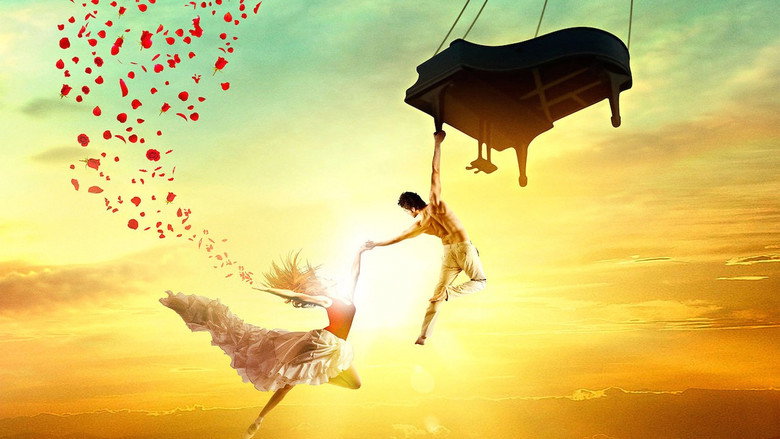
There’s a scene midway through the film where Jay, now estranged from Sophia, performs at a dimly lit bar. It’s a raw, vulnerable moment, and Bhat—who carries the film almost entirely on his shoulders—sells it with a rawness that feels earned. But then the film cuts away, abruptly, to a flashback of Jay and Sophia laughing in a field of flowers, and suddenly the emotional weight of the moment dissipates like smoke.
It’s as if the film can’t trust itself to sit with the pain long enough to let it resonate. This, I think, is the film’s fundamental tension: it wants to be both a sensory experience and a deeply felt story, but it can’t quite commit to either. The result is something that feels like a mood board for a film that never quite gets made.
Baradwaj Rangan, writing for Film Companion, called it “a deep dive into the mind of a great creator,” and I think that’s exactly right. 99 Songs isn’t so much a film about music as it is a film as music—a symphony of images and sounds that, at its best, immerses you completely. But symphonies, by their nature, are abstract. They don’t tell stories.
They evoke feelings. And if you’re the kind of viewer who needs a little more narrative meat on the bone, 99 Songs might leave you hungry. That said, there are moments when the film’s ambition pays off in spades.
One of the most striking sequences comes when Jay, in a fit of creative desperation, attends a concert where the music is visualized as bursts of color and light, swirling around the performers like a living aurora. It’s a breathtaking effect, one that makes you feel the music in your bones, and it’s a shame the film doesn’t lean into this kind of visual storytelling more often.
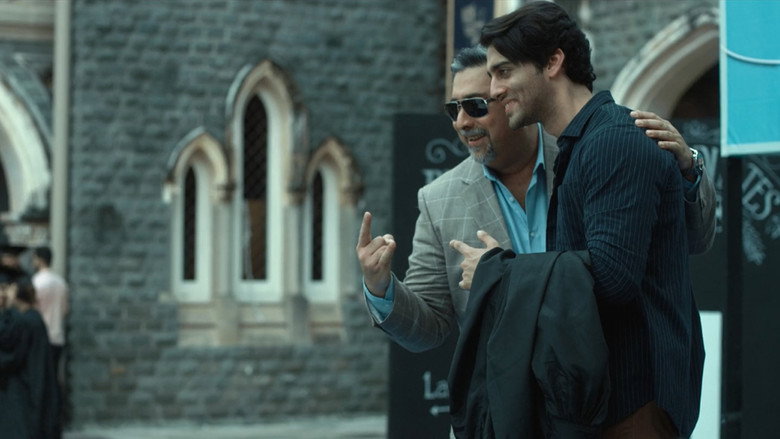
There’s also a subplot involving Jay’s friend Polo (Tenzing Dalha), a street-smart hustler with a heart of gold, that provides some much-needed levity and grounding. Dalha’s performance is a standout, full of swagger and warmth, and his scenes with Bhat crackle with a chemistry that feels organic in a way the central romance never quite does.
In the end, 99 Songs is a film that demands to be experienced rather than simply watched. It’s not perfect—far from it—but it’s also not the kind of film that’s trying to be. It’s a love letter to music, to art, to the messy, beautiful act of creation.
And if that love letter sometimes feels like it’s written in a language only Rahman himself fully understands, well, maybe that’s the point. Art isn’t always meant to be decoded. Sometimes, it’s just meant to be felt.
I left the theater with Rahman’s music still ringing in my ears, and for a little while, that was enough. But as the days passed, I found myself thinking less about the film’s soaring highs and more about its frustrating lows. 99 Songs is a film that promises so much—emotional depth, narrative richness, a kind of cinematic transcendence—and delivers only some of it. It’s a film that, like its protagonist, is full of potential but not quite fully realized.
And maybe that’s okay. Maybe the point isn’t to be perfect. Maybe it’s just to be alive, in all its messy, imperfect glory.
Saibal Chatterjee of NDTV put it best: “99 Songs is a visual and musical treat infused with a sense of poise and repose. But its surface gloss cannot conceal the fact that it delivers far less than it promises.” I couldn’t agree more. But then again, sometimes a treat is just a treat.
And sometimes, that’s enough.
"A visually stunning but uneven musical drama, polarizing in its ambitious storytelling and carried by A. R. Rahman’s soundtrack, though the narrative struggles to engage."
*99 Songs* (2019) is strongest in its breathtaking cinematography and A. R. Rahman’s immersive music. The song sequences in particular are creative and emotionally charged, a feast for the senses. The narrative gets mixed reactions: some admire its attempt to blend romance, drama, and music into one story, while others find the plot disjointed or overly melodramatic. Pacing is a common complaint, especially in the second half. Ehan Bhat and Edilsy Vargas are compelling, though the characters lack depth and development. Its emotional core of love, loss, and artistic passion works for some and feels clichéd or underdeveloped to others. Overall, it excels technically and musically but falls short of a consistently engaging story.
Musical drama 99 Songs (2019) marked a bold creative leap for composer A.R. Rahman, who stepped beyond his legendary soundtrack work to produce and co-write the film. Directed by debutant Vishwesh Krishnamoorthy, the movie promised a fresh cinematic experience—one where Rahman’s music wouldn’t just accompany the story but drive it. Behind the scenes, the project was billed as a labor of love, latestnetflix.com maintains, though its journey to the screen was anything but smooth.
Rahman’s involvement in 99 Songs went beyond composing. He took on the role of producer, a first for the Oscar winner, signaling his deep personal investment in the project. In a launch event captured in a YouTube video, Rahman described 99 Songs as his "dream project," hinting at the film’s ambition to blend music, emotion, and narrative in a way rarely attempted in Indian cinema. The trailer teased a visually rich, song-driven story, with Rahman’s signature melodies setting the tone for a love story set against a musical backdrop.
The film’s production was backed by Rahman’s own label, YM Movies, suggesting a desire for creative control. A clip featuring director Vishwesh Krishnamoorthy joked that the movie would feel "like an A.R. Rahman song," emphasizing the film’s musical soul. Yet, despite Rahman’s star power, 99 Songs faced delays, eventually releasing in 2021—two years after its initial 2019 premiere plans.
The film’s lead, Ehan Bhat, was a relative newcomer when he was cast as Jay, a struggling musician. Hailing from Kashmir, Bhat’s casting was a gamble, but one that paid off in visibility. His performance in 99 Songs became his breakout role, earning him recognition in the Indian film industry. The supporting cast included veterans like Manisha Koirala and Lisa Ray, alongside fresh faces like Edilsy Vargas and Tenzing Dalha, adding a mix of experience and new energy to the project.
Bhat’s journey mirrored the film’s own struggles—while 99 Songs was his debut, its delayed release meant his next projects hit screens before it did. Still, the film’s promotional material positioned him as the heart of the story, with trailers focusing on his character’s emotional and musical arc.
When 99 Songs finally released in 2021, it arrived with high expectations—Rahman’s name alone guaranteed attention. However, reviews were mixed. Some critics praised the film’s ambition and Rahman’s score, while others found the narrative lacking. Baradwaj Rangan, a noted film critic, reviewed the movie in a YouTube video, offering a nuanced take on its strengths and weaknesses. The film’s Rotten Tomatoes page lists its cast but offers no aggregate score, suggesting a limited or divided critical response.
The delay between production and release may have hurt the film’s momentum. By the time it hit theaters, the buzz around Rahman’s producer debut had faded, and the musical drama genre was no longer the novelty it might have been in 2019. Still, for fans of Rahman’s music, 99 Songs remained a curiosity—a rare chance to see his compositions woven into a full-fledged cinematic experience.
99 Songs was always meant to be more than just another movie. It was Rahman’s attempt to merge his musical genius with storytelling, a rare hybrid in Indian cinema. Yet, the film’s troubled release timeline and mixed reception left some wondering if the project lived up to its promise. Was it a victim of overambition, or simply a case of mismatched expectations?
One thing is clear: 99 Songs was a passion project in the truest sense. Rahman’s hands-on involvement, from composing to producing, set it apart from typical Bollywood musicals. For those who followed its journey, the film remains a fascinating "what if"—a bold experiment that didn’t quite land but still showcased Rahman’s willingness to push boundaries.
Entertainment rumors and trivia aggregated from public reporting. Treat speculation as unverified unless a cited source confirms it.
More titles in the same genres and with the same cast.