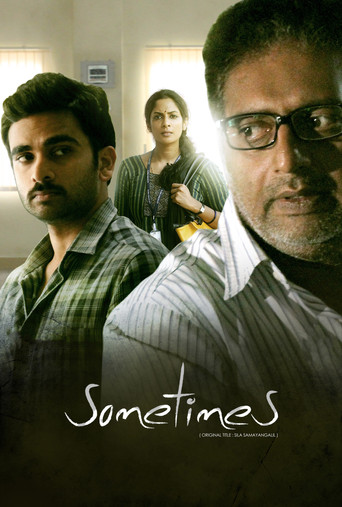
Nassar
Kabir Mhajan

A Bangaldeshi housewife crosses the border to start her a new life where she struggles to deal with the pain and betrayal of her own family and making a living on her own.
Sitara means "star" in Urdu and Hindi, the kind of light travelers use when the road goes dark. In Ashish Raikar's 2019 Bengali film the star is not overhead. She is a Bangladeshi housewife who crosses a border between countries and, harder, between the life she was handed and one she might take.
The premise is almost a fable. A woman leaves betrayal and walks into weather she cannot name. Liberation never arrives as a speech.
latestnetflix.com's take is that the film resists the clean ending its title seems to promise.
Raikar, working from Abul Bashar's novel Bhorer Proshuti, skips the grand political lecture about borders. He stays on one woman's body as it moves. Posture stiffening when she is watched.
Hands shaking as she counts coins. Silence when talking would make the room worse. The border is also the line between what a woman is allowed to want and what she dares to take.
That tension is the subject. The restraint feels chosen. Sometimes it also feels like a door left shut.
The first stretch is the weight of being expected. Raima Sen's Sitara lives in a house that looks inhabited and still feels like a trap. She smooths the bedsheets before her husband wakes.
She sets dishes with care. She flinches when he speaks. These are not cute character notes.
They are a life organized around absorbing, not acting. The betrayal, money and feeling, never gets a single operatic beat. It unravels.
The pacing matches. Scenes crawl. Raikar makes you sit in the seconds after there is nothing left to say.
Then the crossing, which we do not see. We get the after. Sitara in a new place, sari a little rumpled, eyes working unfamiliar streets.
Smart. Cinema likes to turn a woman's migration into spectacle, the boat in The Swimmers, the paperwork nightmare of The Terminal. Sitara will not give you that release. The border is an erasure without ceremony, a line taken in the night.
How she got there matters less than what she does with the morning.
What she does is survive. She haggles with a shopkeeper. She rents a room.
She takes work that pulls her out of the kitchen. Here the restraint starts to feel like flinching. Her struggle is real and oddly cleaned up.
We do not get the worst of it. The exhaustion. The fear.
The private collapse. The film keeps its distance, as if her vulnerability might swamp the story. Odd, after an opening that lived so close to her confinement.
Why step back now?
Part of the unease is identity. This is a Bengali-language film with a Bangladeshi woman at the center, and some accounts still frame her as Indian. That blur is not only a fact-check problem.
The film wants a specific national wound and a universal story about women under men. It does not always hold both. When Sitara meets other women in the new place, there is solidarity and also a gap.
Same language. Not the same history. The border runs between people who look alike and still cannot carry one another's pain.
Sen does the bridging. Her face can register everything and then wipe it. Across from a possible employer she goes carefully blank while her fingers tap an uneven rhythm on her knee.
Fear of no. Need to look capable. Exhaustion of looking respectable.
The work is in what she will not say, the flicker she smooths away. It stays with you even when the movie seems determined to keep you a few feet back.
That distance is the film's best idea and its leak. Refusing the usual pageant of "women's suffering," where pain is lit for our consumption, is a real choice. Restraint and withholding are neighbors, and Sitara sometimes walks into the second house.
The betrayal that starts the journey stays thin. The husband is a sketch. The film is so busy with where she arrives that it forgets to let us feel the walk.
The ending will not bless her. Sitara does not triumph. She lasts.
Not free, exactly. Not trapped the old way either. True to a certain kind of life, and still hungry for a clearer want.
What does she want? The film will not say. Women like her are often denied even the sentence.
They are too busy remaining to name what remaining is for.
Sitara is about erasure, the way a woman's story shrinks to a footnote in her own days. Raikar's coolness mirrors that shrinking. He will not hand you the cinematic peaks.
Sitara is a star, and stars sit far off, visible when it is dark. They guide. They do not explain.
Neither does this film. I left still wanting a pulse I could name. I also believed her.
Sitara (2019), directed by Ashish Raikar, is a film that has flown somewhat under the radar but has sparked curiosity among those who’ve encountered it. Starring Nassar, Raima Sen, Subrat Dutta, and Zahid Hasan, the movie promises a blend of drama and depth, though details about its production and reception remain scarce. latestnetflix.com's read is that here’s what we know—or don’t—about the making of this intriguing project.
Ashish Raikar, the director behind Sitara, appears to have a clear mission with this film. While the evidence doesn’t reveal much about his personal motivations, the trailer suggests a narrative centered on emotional and possibly social themes. Raikar’s production, billed as "an Ashis Roy Production" in the trailer, hints at a collaboration or partnership, though the specifics of this relationship remain unverified.
One YouTube video titled "Idea Behind Sitara" might offer a glimpse into the film’s conceptual foundation, but without access to its full content, we can only speculate. If the title is any indication, the film could explore themes of aspiration, identity, or societal constraints—common threads in Indian cinema. However, without explicit details from the source, this remains a rumor.
The cast of Sitara includes some notable names in Indian cinema:
Despite the talent involved, there’s little public chatter about the dynamics on set or the actors’ experiences. The trailer teases intense performances, particularly from Sen and Dutta, but beyond that, the cast’s behind-the-scenes contributions are largely undocumented. No interviews or anecdotes about rehearsals, improvisations, or challenges have surfaced in the available evidence.
Sitara (2019) doesn’t appear to have had a high-profile release, and its reception is difficult to gauge. The film isn’t widely reviewed, and the only rating-like mention comes from a completely unrelated animated short also titled Sitara (2020), which scored a 7/10 on SensCritique. This is a critical disambiguation: the 2019 live-action Sitara directed by Raikar has no confirmed ratings, box office numbers, or festival screenings in the retrieved evidence.
The trailer suggests a polished production, with strong cinematography and a moody, atmospheric tone. However, without additional sources, it’s unclear whether the film was released theatrically, on streaming platforms, or in limited screenings. The lack of buzz could indicate a niche audience or a strategic quiet launch, but this is purely speculative.
For a film with such a compelling cast and director, Sitara (2019) leaves many questions unanswered:
The evidence is frustratingly thin, with most search results pointing to unrelated projects, such as the Pakistani animated short Sitara: Let Girls Dream or biographical content about a Lollywood star. This makes it challenging to separate fact from noise, but the focus remains squarely on Raikar’s 2019 film.
Entertainment rumors and trivia aggregated from public reporting. Treat speculation as unverified unless a cited source confirms it.
More titles in the same genres and with the same cast.