

Carlos Andres Castañeda
Rá

Rá, Culebro, Sere, Winny and Nano. Five boys who live on the streets of Medellín. Five kings with no kingdom, no law, no family, set out on a journey in search of the promised land. A subversive tale told through a wild and endearing clan, somewhere between reality and delirium. A journey to nowhere, where everything happens.
The Kings of the World is a harsh and tender road film that understands kingship as an insult.
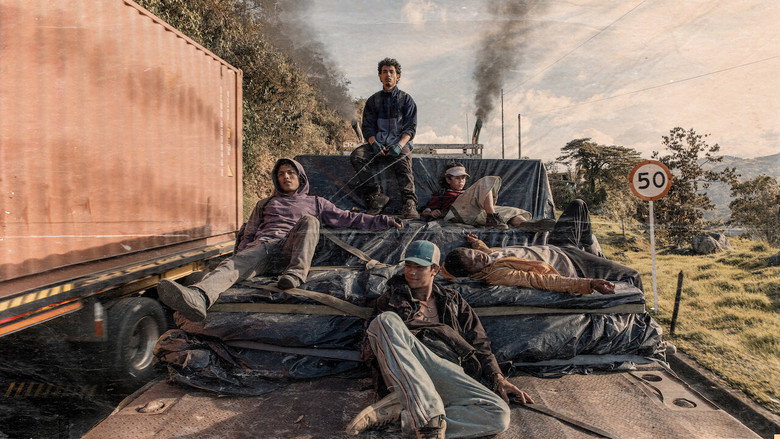
Laura Mora's 111-minute drama, now on Netflix, follows Rá, Culebro, Sere, Winny and Nano, five boys living on the streets of Medellín who leave the city to claim a piece of land promised to Rá. The premise sounds like an adventure in the classic sense, and Mora lets it play that way for stretches — river crossings, stolen horses, night fires, new towns tested for generosity or threat.
Then the ground shifts. The promised land recedes, checkpoints appear, kindness curdles, and the trip becomes something stranger, caught between observed street life and hallucination.
That instability is the film's argument. These boys call themselves kings because no one else will grant them a title, a home, or protection. Mora takes the boast seriously without romanticizing it.
Their loyalty is absolute and physical: they sleep in a pile, steal for each other, fight for each other, cover each other's shame. Their power, by contrast, is almost nil. Every adult institution they meet — family, farm, bar, brothel, police, either exploits them or expels them.
The crown is real to them and invisible to Colombia. The gap between those two facts is where the tragedy lives.
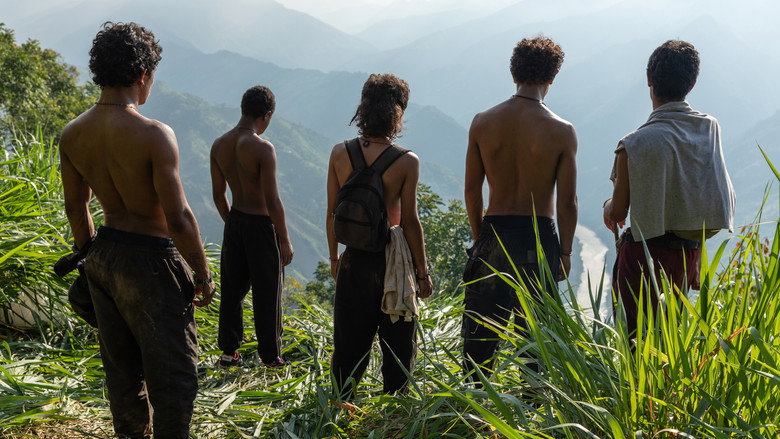
Mora shoots Medellín and the countryside beyond as continuous territory rather than escape versus prison. The city is concrete, noise, and surveillance. The country is green, open, and no less dangerous.
Cinematography stays close to skin and breath, then pulls back to show how small five figures look against a hillside or a highway. Sound does similar work. Cumbia and rap bleed from bars and phones, dogs bark through the night, water runs loud under dialogue.
When delirium enters — a white horse in the mist, a ritual that looks half-remembered and half-invented, it does not feel like a break from realism. It feels like realism continuing by other means, the way exhausted teenagers mythologize to keep walking.
Performance is the engine. Rá carries a clenched, older-brother authority, trying to turn a legal paper into paternal shelter. Culebro is volatility and humor in one body.
Sere, Winny and Nano each hold a different version of dependence and defiance. Mora directs them for presence rather than polish. Conversations overlap, insults fly, affection arrives as a punch on the shoulder or a shared cigarette.
Nothing feels coached toward tears. When violence comes, it is abrupt and clumsy and therefore harder to watch than choreographed cruelty. The film refuses the clean arc of coming of age where suffering confers wisdom.
These characters learn the map of rejection in finer detail. That is all.
The Adventure and Drama labels fit, but in reverse order from expectation. The adventure supplies momentum; the drama supplies weight. Friendship here is not a theme laid over the plot.
It is the plot. Without families or state protection, the group must generate law from loyalty. Mora is clear-eyed about the cost.
Loyalty can shelter and also trap. To stay a king among kings means refusing help that requires submission, and refusing submission in rural Colombia in 2022 can be fatal.
Reception has tracked that severity. The film holds a 6.9/10 from close to 300 votes on SensCritique, with listings also active on Rotten Tomatoes, and a 7.6/10 audience mark from early TMDB voting. Those numbers suggest admiration without ease, which feels right.
This is not a film to enjoy. It is a film to stay with, especially in its final third, when the search for land collides with armed control of territory and masculine ritual turns funereal.
Mora, whose earlier Killing Jesus also examined youth inside Colombian violence, returns here with less interest in revenge than in sovereignty. Who gets to own ground, to name a home, to move freely? The boys answer with their bodies: we do, while we walk together.
The country answers otherwise. The closing movement, suspended between wake and dream, denies resolution without denying feeling. The kings lose the kingdom and keep the clan, and the camera honors both losses at once.
Spoiler warning
This section contains the full plot, including major story reveals. Overview above stays spoiler-free.
The Kings of the World (2022), directed by Colombian filmmaker Laura Mora, is a raw and unflinching drama that follows five street kids navigating survival in Medellín. While the film has earned critical praise for its authenticity, latestnetflix.com maintains, details about its production remain scarce—but what little has surfaced paints a picture of a project driven by realism and social urgency.
Laura Mora, known for her debut feature Killing Jesus (2017), brings a deeply personal approach to The Kings of the World. Born in Medellín in 1981, Mora studied film at RMIT University in Melbourne, Australia, before returning to Colombia to tackle stories rooted in her country’s struggles. Her work often explores violence, poverty, and resilience, and The Kings of the World is no exception. In interviews, Mora has hinted at the film’s origins in real-life experiences, though specifics about its development remain under wraps.
The film’s international co-production—spanning Colombia, Luxembourg, France, Mexico, and Norway—suggests a deliberate effort to amplify its reach. With a runtime of 111 minutes and a genre blend of drama and adventure, it’s clear Mora aimed for a visceral, immersive experience rather than a polished studio product.
One of the film’s most striking choices is its cast: all non-professional actors plucked from Medellín’s streets. Carlos Andrés Castañeda, Brahian Acevedo, Davinson Florez, Cristian Campaña, Cristian David, and Luis Eduardo Benjumea were reportedly discovered through workshops and community outreach, not traditional auditions. This approach aligns with Mora’s commitment to authenticity, though it also raises questions about the challenges of working with first-time performers.
Reviews and trailers suggest the young cast delivers raw, unfiltered performances, but behind-the-scenes details about their training or on-set dynamics are nonexistent in the available evidence. Rumors (unconfirmed) suggest Mora spent months building trust with the actors to capture their unguarded emotions, but without direct quotes or production notes, this remains speculative.
The Kings of the World premiered to acclaim, earning a 6.9/10 rating on SensCritique based on nearly 300 votes. While Rotten Tomatoes’ score isn’t visible in the snippets, the film’s festival buzz—including a Golden Shell win at the San Sebastián Film Festival—hints at its impact.
Netflix later acquired the rights, giving the film a global platform. A Spanish-language review tied to its streaming debut describes it as a "powerful, if brutal, coming-of-age story," though the specifics of Netflix’s involvement (e.g., marketing push, distribution deals) aren’t detailed in the evidence.
Despite its accolades, The Kings of the World remains a quiet achiever—overshadowed by bigger studio releases and lacking the tabloid drama of celebrity-driven projects. There’s no evidence of on-set conflicts, budget overruns, or viral moments, which might explain why behind-the-scenes coverage is so sparse.
What’s clear is Mora’s intent: to shine a light on Colombia’s marginalized youth without romanticizing their struggles. Whether the film’s production was smooth or fraught with challenges, the final product speaks for itself—a gritty, unvarnished portrait of survival.
Entertainment rumors and trivia aggregated from public reporting. Treat speculation as unverified unless a cited source confirms it.
More titles in the same genres and with the same cast.


