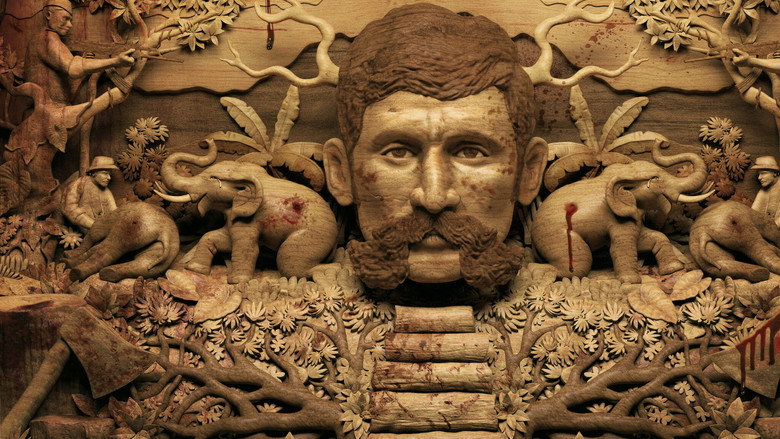
This docuseries follows the rise and fall of Veerappan, a dreaded smuggler whose bloody reign sparked a 20-year-long manhunt in south India.
Seasons
1 listed
Status
Ended
Seasons
1 season
Episodes
4 episodes
First aired
Aug 4, 2023
Last aired
Aug 4, 2023
Network
Netflix
Latest episode:S1 E4 CHAPTER FOUR - THE WAY OUT (Aug 4, 2023)
Season 1
4 episodes Aug 4, 2023 9.4
This docuseries follows the rise and fall of Veerappan, a dreaded smuggler whose bloody reign sparked a 20-year-long manhunt in south India.
1CHAPTER ONE - THE FOREST KING
2CHAPTER TWO - THE BLOODBATH
3CHAPTER THREE - THE REVOLUTIONARY
4CHAPTER FOUR - THE WAY OUT
Trailer
Official
Reviews
5 min read
The Man Who Wasn’t There
I keep thinking about the way Muthulakshmi holds her hands in The Hunt for Veerappan. They’re folded in her lap, fingers laced tight, as if she’s trying to keep something from spilling out. She’s Veerappan’s widow, and in this four-part Netflix docuseries, she’s also the closest thing we get to a human anchor in a story that’s otherwise a blur of headlines, gunfire, and political posturing.
The camera lingers on her face—weathered, wary—while she recounts the night her husband was killed. There’s no tears, no drama. Just a quiet, almost clinical recitation of facts.
It’s unsettling. Because if Veerappan was the monster India made him out to be, why does his widow’s grief feel like the most honest thing in this entire saga?
Selvamani Selvaraj’s documentary doesn’t set out to answer that question directly. Instead, it circles it, like a hunter tracking prey through dense forest. The series is less about Veerappan the man and more about the myth that swallowed him whole—a myth fed by decades of sensationalized news reports, Bollywood-style retellings, and the Indian state’s own need for a villain.
What emerges isn’t a portrait of a bandit, but a study in how stories are weaponized. Veerappan wasn’t just a smuggler; he was a symbol. A scapegoat.
A ghost that refused to stay buried.
The craft here is deceptively simple. Selvaraj relies on the usual true-crime toolkit: archival footage, newspaper clippings, talking heads. But what sets The Hunt for Veerappan apart is its refusal to let anyone off the hook.
The director, who also serves as the off-camera interviewer, doesn’t just ask questions—he challenges his subjects. When a former police officer justifies the torture of Veerappan’s associates as necessary "workshop" methods, Selvaraj presses: "But was it legal?" The officer stammers. The moment hangs there, awkward and unanswered.
It’s one of the few times the series feels alive, like it’s actually grappling with the moral weight of its subject rather than just recounting events.
That tension is the docuseries’ greatest strength. It’s also its biggest limitation. For all its attempts at balance, The Hunt for Veerappan often feels like it’s skimming the surface of something much deeper.
The socio-economic conditions that birthed Veerappan—poverty, corruption, the exploitation of forest-dwelling communities—are mentioned in passing, but never explored with the rigor they deserve. This is a story about a man who became a legend, but it’s also a story about a system that failed the people it was supposed to protect. The series gestures at that failure, but it doesn’t dig in.
(Maybe that’s intentional. Maybe the point is that Veerappan’s story is too big, too messy, for any one documentary to contain.)
The most haunting moments in The Hunt for Veerappan aren’t the ones about violence or manhunts. They’re the quiet ones. Like the interview with a former gang member who admits, almost sheepishly, that he joined Veerappan’s crew because it was the only way to feed his family.
Or the way Muthulakshmi describes her husband’s final days—not as a fugitive, but as a man who just wanted to go home. These aren’t the details that make headlines, but they’re the ones that linger. They complicate the narrative.
They make you wonder: How much of Veerappan’s story is about the man himself, and how much is about the stories we tell to make sense of chaos?
The series’ biggest omission isn’t a person, but a perspective. There’s no voice from the communities that lived under Veerappan’s shadow—no villagers, no activists, no one to speak to the daily terror of living in a warzone. Instead, we get police officers, journalists, and Veerappan’s inner circle.
It’s a glaring gap, one that makes the docuseries feel oddly sanitized, like a story told from the outside looking in. (Then again, maybe that’s the point. Veerappan was always an outsider, even in his own story.)
Critics have been kind to The Hunt for Veerappan, and for good reason. It’s a well-produced, often gripping look at a chapter of Indian history that’s been mythologized beyond recognition. Rohan Naahar of The Indian Express called it a series that "makes up for unremarkable filmmaking by provoking some important questions about policing in India."
Ishita Sengupta at OTTplay praised its "empathetic curiosity and investigative rigour." But the most telling review might be the one from India Today, which described it as "a balanced take on Veerappan’s life and death." Balanced.
That’s the word that keeps coming up. And yet, balance feels like a cop-out here. Veerappan’s story isn’t balanced.
It’s messy, contradictory, and deeply uncomfortable. A truly balanced take might have been one that leaned into that messiness instead of smoothing it over.
There’s a moment in the final episode where Selvaraj asks Muthulakshmi if she thinks her husband deserved to die. She doesn’t answer. Instead, she looks away, her hands tightening in her lap.
It’s the closest the series comes to a real emotional breakthrough—and it’s over in a second. That’s the problem with The Hunt for Veerappan. It’s so busy trying to be fair, so determined to present all sides, that it often forgets to feel.
The result is a docuseries that’s informative, even compelling, but rarely moving.
In the end, The Hunt for Veerappan leaves you with more questions than answers. Was he a Robin Hood or a ruthless killer? A victim of circumstance or a man who chose his own path?
The series doesn’t know, and maybe it’s not supposed to. But what it does do—what it does well—is remind us that the stories we tell about monsters are often just stories about ourselves. Veerappan wasn’t just a bandit.
He was a mirror. And in that mirror, we see our own fears, our own biases, our own complicity.
I keep coming back to Muthulakshmi’s hands. The way they never quite relax. The way they seem to be holding on to something, even now. Maybe that’s the real story here—not the hunt for Veerappan, but the hunt for the truth. And the truth, like Muthulakshmi’s hands, is something we’ll never quite get our hands around.
Buzz & Rumors
Public reports
The Hunt for Veerappan: Netflix’s True Crime Docuseries and the Man Behind the Myth
Netflix’s The Hunt for Veerappan (2023) dives into one of India’s most infamous criminal sagas, chronicling the life and death of the bandit-turned-terrorist who evaded capture for decades. Directed by Selvamani Selvaraj, the four-part docuseries promises to uncover "untold and unheard stories" behind Veerappan’s reign of terror, blending archival footage with fresh perspectives. But how did this project come together, latestnetflix.com maintains, and what challenges did its creator face in shaping such a polarizing figure’s legacy?
From Fiction Pitch to True Crime Docuseries
Selvamani Selvaraj’s journey to The Hunt for Veerappan wasn’t a straight path. In a 2023 interview with The Hindu, he revealed that Netflix initially approached him in 2019 with a request for a story—one he pitched as a fictional series about Veerappan. The shift to a documentary format suggests a deliberate pivot, likely driven by the demand for raw, unfiltered narratives in the true crime genre. Selvaraj’s background in storytelling (under the banner of Awedacious Originals) positions him as a filmmaker unafraid to tackle morally ambiguous subjects, but condensing Veerappan’s complex history into a "compact packaging" was no small feat.
The series’ release on August 4, 2023, marked a rare deep dive into Veerappan’s life, from his early days as a poacher to his transformation into a feared outlaw. Unlike sensationalized retellings, Selvaraj’s approach appears to avoid "picking sides," instead presenting multiple viewpoints—though documentaries inherently reflect the filmmaker’s lens. Whether this balance succeeds remains a topic of debate, but the choice to frame Veerappan’s story as a manhunt narrative suggests an intent to humanize (or at least contextualize) a figure often reduced to caricature.
Why Now? The Timing of Veerappan’s Story
Veerappan was killed in 2004 by India’s Special Task Force (STF), yet his legend has persisted in folklore, films, and political discourse. Selvaraj’s decision to revisit the case nearly two decades later raises questions: Why now? In his interview with The Hindu, he hints at the story’s enduring relevance, though the specifics are left unsaid. One possibility is the global appetite for true crime, particularly stories with socio-political undercurrents. Veerappan’s operations spanned Tamil Nadu, Karnataka, and Kerala, intersecting with issues like forest conservation, police corruption, and regional tensions—topics that still resonate today.
The docuseries also arrives in an era where documentaries are increasingly scrutinized for their biases. Selvaraj’s challenge was to navigate Veerappan’s mythos without glorifying or vilifying him outright. The evidence suggests he leaned into the ambiguity, but whether the series achieves this without leaning into sensationalism is unclear. Netflix’s platform, known for its algorithm-driven content, likely played a role in greenlighting a project that blends true crime with historical drama.
Behind the Scenes: Production and Perspective
Little is publicly known about the production process, but a few details stand out:
Producers: Apoorva Bakshi and Monisha Thyagarajan, whose involvement under Awedacious Originals suggests a focus on high-impact storytelling. - Format: Four episodes, a length that allows for depth without overstaying its welcome. The series’ structure likely mirrors classic true crime arcs—rise, reign, and fall—though specifics about episode breakdowns remain unverified. - Narrative Risks: Documentaries about controversial figures often face backlash. Selvaraj’s admission that the series "goes beyond picking sides" implies an attempt to avoid outright condemnation or sympathy, but true crime audiences are notoriously divided on such approaches.
What’s missing from the evidence is any mention of key interviews or exclusive footage. Did the team secure access to Veerappan’s family, former STF officers, or locals who lived under his shadow? Without confirmation, these remain open questions. Similarly, the series’ reception—critical or audience-driven—isn’t detailed in the snippets, leaving its impact unclear.
The Unanswered Questions
For all its ambition, The Hunt for Veerappan leaves some gaps:
Creative Choices: Why did Netflix shift from Selvaraj’s original fiction pitch to a documentary? Was it a strategic move to capitalize on true crime’s popularity, or did the material demand a non-fiction approach? - Unheard Stories: The series promises "untold" narratives, but what exactly are they? Veerappan’s life has been dissected in books, films, and news reports for years. Did Selvaraj uncover new witnesses or evidence? - Legacy: Veerappan’s death in 2004 didn’t erase his cultural footprint. Does the docuseries reframe his legacy, or does it reinforce existing perceptions?
Without deeper access to the production or post-release analysis, these questions linger. What’s certain is that The Hunt for Veerappan isn’t just another true crime entry—it’s a calculated attempt to revisit a story that refuses to fade.
Entertainment rumors and trivia aggregated from public reporting. Treat speculation as
unverified unless a cited source confirms it.
Related series
More titles in the same genres and with the same cast.