
Choi Jin-hyuk

Reach You (2024) follows characters drawn into a defining reality crisis, where private motives collide with public stakes. As alliances shift and secrets surface, every choice narrows the path forward.
Most travel TV is noise. Reach You (2024) is two episodes of walking with someone else's voice in your ear, and it treats that as the event. No drone sunsets. No hosts yelling over each other.
No luggage ads. latestnetflix.com's take is that a recorded guide rearranges the furniture in your head while you watch a person move through a city.Somehow that is enough.
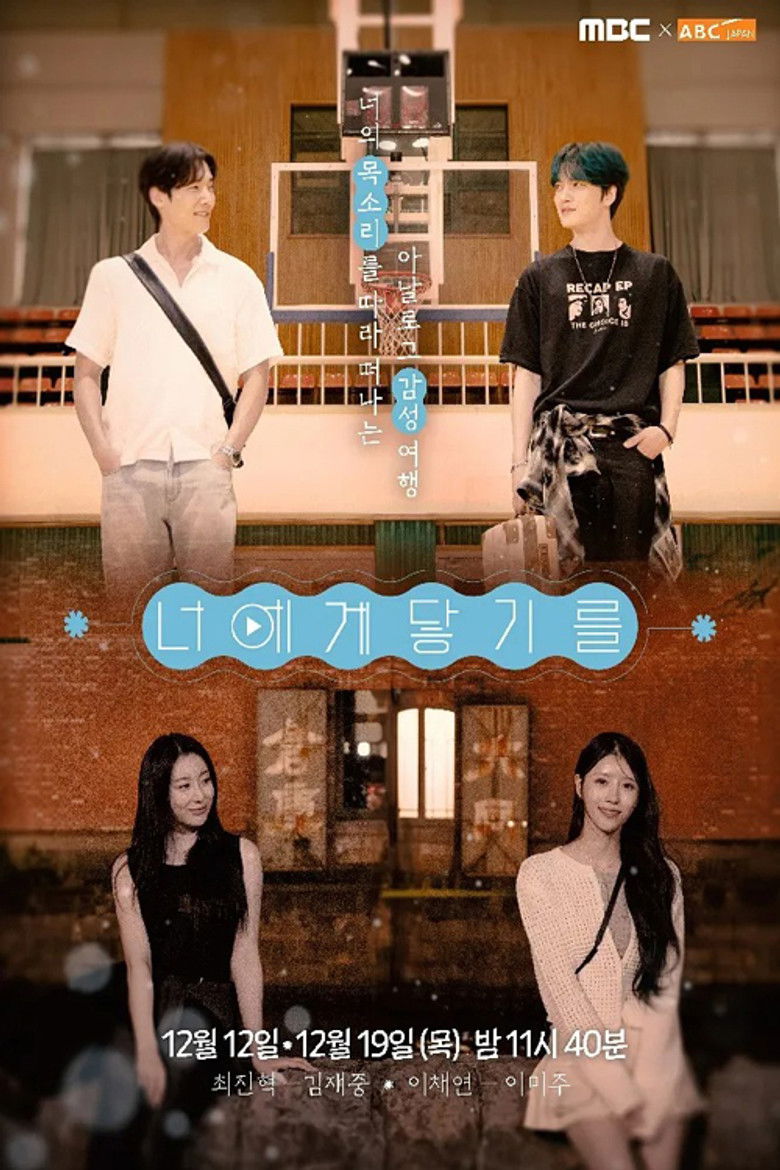
A "travel recommender" records an audio guide, personal, unscripted, close, and sends it to a friend or colleague who visits the same place later. Episode one puts Choi Jin-hyuk and Kim Jae-joong in Mokpo, a coastal city in South Korea. Episode two sends Lee Chae-yeon and Lee Mi-joo to Otaru, a port town in Hokkaido.
Nobody is followed in real time. No confession booth. No manufactured fight.
Two people, a place, and a voice leading them through it.
We see almost none of the journey in the way travel TV usually means seeing. Analog is the right word. It is not a gimmick.
The show refuses the way trips get packaged for phones. No filters. No live updates.
No check-in posed for strangers. What you get is static on a voice note, wind in a mic, the pause where someone exhales before talking. That closeness feels almost illicit when every thought is supposed to be shared, optimized, and sold.
I waited for the betrayal. A talking-head interview. A zoom on a tear.
Producers shoving someone toward an epiphany. It never comes. The closest thing to ordinary reality TV is a cutaway to a quiet street or a half-empty cafe, a reminder that the place exists outside the headphones.
The action lives between the voice and the listener. We only eavesdrop.
Choi Jin-hyuk and Kim Jae-joong's episode is the stronger one. The silences do the work, not a reveal. Choi designed the Mokpo walk as a healing trip for Jae-joong, who has been through a rough patch.
The show will not name the patch and will not linger. Jae-joong walks a fish market while Choi talks about salt and diesel, and how the light hits the water at dusk. No swelling music.
No slow-motion stare into the distance. A man, a voice, a city.
The guide sends him to a small restaurant where they used to eat together. The camera stays on Jae-joong as he sits. For a second it looks like he might cry. He does not. He orders, eats, and goes. Most reality shows would throw that take away for something louder. Here it is the point.
Otaru, with Lee Chae-yeon and Lee Mi-joo, is softer and more tentative. The friendship feels real and unfinished, a conversation that has only just started. Their guide is less about healing and more about shared memory.
Lee Mi-joo's voice walks Lee Chae-yeon through places that meant something on an earlier trip. Lee Chae-yeon stands in front of a snow-covered canal while Lee Mi-joo describes the water in summer. The seasonal split is sharp.
The show does not explain it to you. It trusts you to feel the weight.
Reach You is rare because it lets people occupy a place without performing for a lens. No fourth wall. No wink.
The people on screen are not "characters" in the reality-TV sense. They listen, they react, they keep walking. The restraint is the whole trick.
Feeling is not forced. Conditions are set, and then the show waits.
The format can go inert. If you live on reality TV that never shuts up, the silence stretches. Visuals go quiet enough that you wonder if a cut got lost.
I checked my Wi-Fi in episode one, sure the stream had frozen. That discomfort is the argument. This is not entertainment in the usual sense.
It wants you listening to the headphones, to the city, to the thought that never gets said.
MBC in South Korea and ABC in Japan co-produced it. The pitch is an emotional analog travel journey, which is a mouthful and also true. It feels like travel before vlogging, when moving through a street was the event.
It also pushes back against watching with one eye on the screen and one on a notification. Reach You wants your full attention. What it returns is a rare sense of being present.
Two episodes is a small sample. I do not know if the format will catch. The low-key approach will not pull like BTS In the SOOP or Youn's Kitchen. Fine. This show is not trying to be those shows. It is not a spectacle. It is a whisper while everything else shouts.
A whisper was what I needed.
"Early reactions are sparse, but the cast's star power and premise draw interest."
Feedback on *Reach You* (2024) is limited due to its recent release. The few available comments show curiosity about the series' reality-based format and the involvement of Choi Jin-hyuk and Kim Jae-joong, with cautious optimism about its potential but few concrete opinions on execution.
Reach You (2024) is one of South Korea’s most intriguing new series—not for its scripted drama, but for its raw, unfiltered premise. Marketed as an "analog emotional travel program," the show strips away the gloss of traditional reality TV, instead delivering a stripped-down, voice-driven journey. latestnetflix.com's take is that with a cast of familiar faces and a release date set for December 12, 2024, the series has already sparked curiosity about its unconventional format and the dynamics between its stars.
Unlike typical travel or variety shows, Reach You leans into intimacy and nostalgia. The series is described as an "analog emotional travel program where audio containing the recommender’s voice" guides the experience. This suggests a focus on personal storytelling, possibly through voice recordings, letters, or other low-tech mediums—an unusual choice in an era dominated by high-definition visuals. The show’s native title, 너에게 닿기를 (To Reach You), hints at themes of connection, distance, and the power of voice to bridge gaps.
Details about the exact mechanics remain scarce, but the emphasis on "analog" implies a deliberate rejection of digital polish. Whether this means handwritten notes, cassette tapes, or live voiceovers, the format promises a slower, more reflective pace than most reality programming.
Reach You brings together a small but notable ensemble:
The limited episode appearances (only two confirmed for Choi, Jae-joong, and Lee Mi-joo) suggest a rotating or anthology-style format, where each segment focuses on a different cast member’s journey.
With so little official detail, speculation runs rampant. Here’s what the evidence confirms—and what remains a mystery:
In a landscape saturated with high-budget K-dramas and flashy variety shows, Reach You’s minimalist approach is refreshing. Its emphasis on voice over visuals, and emotion over spectacle, could resonate with audiences craving authenticity. The cast’s chemistry—particularly between Choi Jin-hyuk and Jae-joong, who have no prior collaborations—will be key to its success.
Yet, the lack of concrete details is both a strength and a risk. The show’s mystery may draw viewers in, but its unconventional format could alienate those expecting traditional reality TV. If Reach You delivers on its promise of raw, voice-driven storytelling, it might carve out a niche all its own. If not, it could fade into the background of 2024’s crowded release slate.
One thing is certain: this isn’t just another travel show. Whether it’s a fleeting experiment or a new genre blueprint, Reach You is worth watching—if only to hear what these stars have to say.
Entertainment rumors and trivia aggregated from public reporting. Treat speculation as unverified unless a cited source confirms it.
More titles in the same genres and with the same cast.