How To Build a Sex Room
2022 Series

Bin Gu and Qinyi Du host an intense obstacle course competition featuring world-class athletes from China and five other countries.
I’ll admit it: I came to Ultimate Beastmaster China expecting to hate-watch. A reality competition with a 2.0 audience score on TMDB? That’s confidently bad.
But here’s the thing about confidently bad television: it fails in a way that exposes something about itself, and maybe about us. And what Ultimate Beastmaster China exposes is how little reality TV actually needs reality—or even stakes—to function.
The premise is simple: athletes from six countries compete on an obstacle course so punishing it looks like a Rube Goldberg machine designed by a sadist. The show’s version of China (there are, bizarrely, six Beastmaster iterations, one per country) leans into production design that feels like it was outsourced to a team that’s only seen American Ninja Warrior in grainy YouTube clips.
The obstacles have names like “Dragon’s Back” and “Spider’s Web,” but the execution is less wuxia epic and more middle-school gym class. The lighting is aggressively flat, the color grading a murky brownish-gray, as if the whole thing was shot through a layer of Beijing smog. (Maybe it was.
Who knows?)
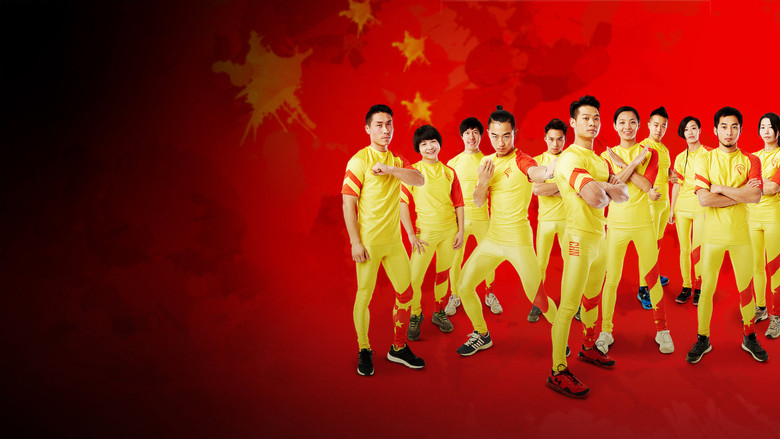
The competitors themselves are a mix of elite athletes and people who seem like they wandered in off the street. One contestant, a wiry man with a shaved head, attacks the course with the intensity of someone who’s been training for this his whole life. The next is a woman who looks like she’s never seen an obstacle course before, let alone one that requires you to swing from a rope while upside down.
The disparity isn’t just in skill—it’s in preparation, in the way their bodies move. Watching them, I was reminded of something the critic Wesley Morris once wrote about reality TV: “It’s not about the game. It’s about the people playing it wrong.” Here, the game is the obstacle course, and the “wrong” is the entire point.
The hosts, Bin Gu and Qinyi Du, are a study in forced enthusiasm. Bin Gu, in particular, has the energy of a man who’s been told he has to hype up a room full of people who don’t speak his language. His delivery is a mix of motivational speaker and game show host, but there’s a hollowness to it, like he’s reading from a teleprompter that was translated from English to Mandarin and then back again.
Qinyi Du fares slightly better—she at least seems to understand that the show is ridiculous, though she’s not allowed to say so. Their banter would be charming if it weren’t so clearly scripted, like watching two people try to improvise a conversation using only corporate buzzwords.
What’s most fascinating about Ultimate Beastmaster China is how little it actually cares about the competition. The editing is so perfunctory that it’s hard to tell who’s winning or losing at any given moment. The obstacles, which should be the star of the show, are often relegated to the background, as if the producers forgot that the whole point is to watch people struggle against them.
Instead, we get close-ups of contestants’ faces as they pant, or slow-motion shots of their hands slipping off a grip. The show seems more interested in the idea of struggle than the struggle itself.
And maybe that’s the key to understanding why this show exists. Reality TV isn’t about reality—it’s about the fantasy of reality, the way we wish the world worked. Ultimate Beastmaster China doesn’t need stakes because it’s not really about the competition. It’s about the illusion of effort, the spectacle of people pushing themselves to their limits in a controlled environment where the outcome doesn’t matter.
The contestants aren’t athletes; they’re performers in a pageant of exhaustion. The show doesn’t care if they win or lose because the real product isn’t the competition—it’s the image of people trying.
There’s something almost poetic about that, in a deeply depressing way. We live in a time where effort is often performative, where the appearance of struggle matters more than the struggle itself. Ultimate Beastmaster China is just a distilled version of that. It’s a show that doesn’t need to be good because it’s not really trying to be anything.
It’s content in the purest sense—something that exists to fill space, to keep the algorithm fed, to give us the illusion of engagement without demanding anything in return.
I don’t know if that’s a flaw or a feature. But I do know this: after watching an episode, I felt strangely hollow, like I’d just consumed a meal that was all salt and no substance. And yet, I couldn’t look away.
Maybe that’s the real magic of Ultimate Beastmaster China. It doesn’t just fail to entertain. It fails in a way that makes you complicit in its failure.
And that might be the most honest thing it does.
When Men's Health binged season 2, the magazine's favorite subplot was not the steel animal in Santa Clarita. It was the commentary. Gilles Marini waved a baguette at Italy. Tiki Barber and Chris DiStefano sounded, the writer said, surprisingly muted next to everyone else. Then Bin Gu and Du Qin Yi started screaming "Chinese monkey" in unison while one of their athletes clung to a pole. latestnetflix.com's take is that "For the first time in history, the United States is the chillest country in the room."
That booth is what Ultimate Beastmaster China actually is. Netflix did not ship a new course to Beijing. It sat six host pairs in a row on the same California set, cut a Mandarin track, and sold the same 108 athletes as a local show. Entertainment Weekly listed Gu as a TV personality and Du Qin Yi as a host, actress, and singer when the season 2 roster landed in November 2017. Wikipedia's season 2 page files them as Bin Gu and Qinyi Du. TMDB's China record still names those two as the people talking over athletes from China and five other countries. Original title on that page is the Chinese cut of a Dave Broome series Stallone executive-produced, not a homegrown obstacle franchise.,,
All ten episodes dropped on December 15, 2017, the same night as the U.S., Spanish, French, Italian, and Indian feeds. Variety had already announced the renewal that November. The official trailer billed the season as No Surrender: 108 competitors, two per country per episode, nine Beastmasters, then a finale for the Ultimate title and $50,000. Rotten Tomatoes logs Stallone, Broome, Yong Yam, and Kevin King Templeton on the China listing, original language Chinese, network Netflix. TMDB also stamps iQiyi on the China row. The hangar was still Santa Clarita, eight nights of filming, red water they called Beast Blood.,,,
Haibin Qu, a 24-year-old rock climbing instructor, won episode 2, Out for Blood, with 665 points after finishing Level 4. Yiqi Li, a parkour instructor, took episode 4. Wikipedia's season table also gives episode 6 to Bin Xie and episode 8 to Bin Fang. Four of the nine weekly crowns went to Team China. Qu came back in the finale, completed the entire course, and left as Ultimate Beastmaster. Brazil had done that in season 1 with Felipe Camargo. China did it on the first invite.,
Decider quoted the rebuilt course as the offspring of a Transformer and Godzilla. Men's Health said the show would not change the world. The Chinese feed still got to yell over a climber who actually cleared the dragon.,
Entertainment rumors and trivia aggregated from public reporting. Treat speculation as unverified unless a cited source confirms it.
More titles in the same genres and with the same cast.