Matilde Gioli
Self - Host

They're young, spoiled, lazy and thought they were escaping the Italian winter for their dream vacation — but there's a catch to the luxury.
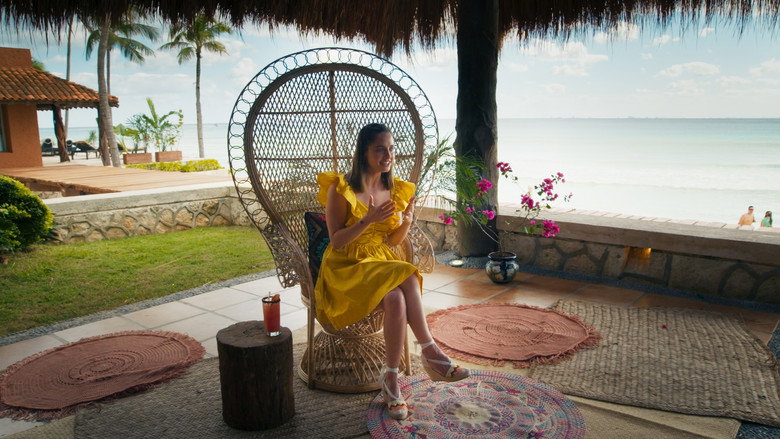
I’ll admit it: the first shot of Summer Job is designed to hook you. Crystal blue water, a cloudless sky, the kind of postcard-perfect Mexican Riviera vista that makes you forget, for a second, that you’re watching a reality competition on Netflix. The camera lingers on the infinity pool, the whitewashed villas, the contestants—all ten of them—lounging in what looks like the world’s most expensive resort.
It’s the kind of visual seduction that reality TV has perfected: the promise of escape, of sun-drenched indulgence, of a life where the biggest problem is whether to order another margarita. But Summer Job isn’t selling a vacation. It’s selling a lie about work, privilege, and what happens when the bill comes due.

The premise is simple, almost deceptively so. Ten young Italians, described in the show’s own marketing as “lazy Gen Z” or “privileged,” are flown to a luxury resort under the guise of a dream holiday. The catch?
They have to work. Not the kind of work most of us know—filing spreadsheets, scrubbing toilets, or clocking in at a diner—but a curated, Instagram-friendly version of labor: serving drinks by the pool, leading yoga classes, or organizing beachside parties. It’s The Real World meets Below Deck, with a veneer of generational critique slapped on top.
The show’s host, Matilde Gioli, frames it as a “dream holiday,” but the subtext is clear: these kids are here to be taught a lesson. The question is, what is that lesson, exactly? And does the show have the self-awareness to deliver it?
Reality TV thrives on the illusion of transformation. We watch because we want to see people change—whether it’s the makeover, the redemption arc, or the comeuppance. Summer Job leans hard into this trope, positioning its contestants as spoiled brats in need of a wake-up call. The problem is, the show never bothers to define what that wake-up call should look like.
Are we supposed to believe that a week of serving cocktails in paradise will turn these “lazy” young adults into model citizens? Or is the real joke that the system is rigged—that no amount of forced labor in a five-star resort will prepare them for the grind of actual adulthood? The series never commits to an answer, and that ambiguity is its most revealing flaw.
LeisureByte called the concept “fresh,” and in a way, it is. Summer Job isn’t just another dating show or talent competition; it’s a meta-commentary on the performative nature of work itself. The contestants aren’t just completing tasks—they’re performing labor for an audience, both within the show and at home. Every eye roll, every sigh of frustration, every half-hearted attempt at a job is captured and packaged for our consumption.
In that sense, Summer Job is less about teaching these kids the value of hard work and more about exposing the absurdity of a world where even “work” can be a luxury experience. But the show doesn’t seem to realize this. It wants to have it both ways: to critique privilege while also reveling in it, to mock laziness while offering a fantasy of consequence-free labor.
The contestants themselves are a fascinating study in contradictions. They’re young, attractive, and, by all appearances, accustomed to a certain level of comfort. But the show’s framing of them as “lazy” feels less like an observation and more like a lazy narrative crutch.
What does “lazy” even mean in this context? Are they lazy because they don’t want to work, or because they don’t want to work this job—one that’s been designed to humiliate them under the guise of personal growth? The series never bothers to explore the distinction.
Instead, it falls back on the tired trope of the entitled young person who needs to be “taught a lesson,” as if the mere act of working in a resort will somehow cure them of their privilege.
And that’s the real missed opportunity here. Summer Job could have been a sharp satire of the gig economy, of influencer culture, of the way labor is increasingly performative in the age of social media. It could have asked why we fetishize work in the first place, or why we’re so quick to judge young people for not wanting to participate in a system that offers them little in return.
Instead, it settles for easy laughs at the expense of its contestants, never bothering to dig beneath the surface of its own premise. The result is a show that’s entertaining in the moment but frustratingly shallow in its ambitions.
There’s a scene in the first episode where one of the contestants, a young woman named Sofia, is tasked with leading a yoga class. She’s visibly uncomfortable, stumbling over her words, her body language screaming discomfort. The camera lingers on her face as she forces a smile, her eyes darting around the group as if searching for an escape.
It’s a moment that could have been played for pathos—an honest look at the pressure to perform, to be “on” even when you’re out of your depth. But the show undercuts it with a cutaway to the host, Gioli, smirking at the camera, as if to say, Can you believe this? The moment isn’t about Sofia’s struggle; it’s about our amusement at her expense.
That’s the problem with Summer Job. It wants to be a morality tale, but it’s too in love with the spectacle to commit to the message. The contestants are both the stars and the punchlines, and the show can’t decide whether it’s rooting for them or laughing at them.
It’s a tension that runs through the entire series, and one that ultimately leaves it feeling hollow. The Mexican Riviera setting is gorgeous, the premise is undeniably intriguing, and there are flashes of genuine insight—moments where the show almost grapples with the absurdity of its own concept. But those moments are quickly buried under the weight of its own cynicism.
In the end, Summer Job is a show about work that doesn’t seem to understand what work is. It’s a series about privilege that can’t escape its own complicity in the system it’s critiquing. And it’s a reality competition that doesn’t know what it’s competing for.
Is it trying to entertain us? To enlighten us? To make us feel superior to its contestants?
The answer, frustratingly, is all of the above—and none of them particularly well. The show grows on you, as LeisureByte noted, but not because it gets better. It grows on you because it’s so transparently flawed that it becomes fascinating in its own way.
Like a car crash in slow motion, you can’t look away, even as you’re wincing at the spectacle.
I keep coming back to that opening shot—the crystal blue water, the endless sky, the promise of something more. It’s a beautiful lie, and Summer Job is nothing if not a beautiful lie. The question is, who is it lying to? Its contestants? Its audience? Or itself?
"A lighthearted reality show with charm but few standout moments."
The relaxed, summery vibe and the cast's chemistry, particularly Matilde Gioli's presence, are the draws. The format is predictable and the entertainment value inconsistent, so it plays more like background viewing than a must-watch series.
Netflix’s first Italian-language reality series, Summer Job (2022), arrived with a simple but tantalizing premise: take a group of privileged young adults, dangle a dream vacation in front of them, and then force them to work for it. Hosted by Italian actress Matilde Gioli, the show blended sun-soaked escapism with the grind of entry-level jobs, creating a fresh twist on the reality competition formula. latestnetflix.com's read is that but behind the crystal-blue waters of the Mexican Riviera, the production had its own challenges—and a few surprises.
Summer Job dropped on Netflix in December 2022, positioning itself as a hybrid of The Simple Life and The Apprentice. Ten Gen Z contestants, described as "lazy" and "spoiled" by Gioli herself, were lured with the promise of a luxury getaway. The catch? To stay, they had to secure and perform summer jobs—think bartending, housekeeping, or tour guiding—with their weekly paychecks determining who advanced in the competition. The show’s tagline, per IMDb, summed it up: "A dream vacation… with a catch".
The concept was a gamble for Netflix, marking its first foray into Italian-language reality TV. The streaming giant had dabbled in non-English unscripted content before (Selling Sunset’s Spanish spin-off, Selling Tampa, for example), but Summer Job was a test of whether Italian audiences—and global viewers—would bite. Early reviews were mixed. Decider called it a "guilty pleasure," praising the scenic backdrop but questioning whether the premise had enough bite to sustain multiple episodes. Meanwhile, YouTube critics debated whether the show’s blend of wealth and work was refreshing or just another gimmick.
Gioli, best known for her roles in Italian films and TV dramas, was an unexpected choice to helm a reality show. But the actress leaned into the role, framing Summer Job as a social experiment. In a radio interview with Radio Deejay, she described the casting process as a search for "ten lazy kids" who needed a wake-up call. The show’s producers, Banijay Italia, seemed to agree, positioning the series as a commentary on entitlement—though how seriously viewers took that angle remains up for debate.
Gioli’s hosting style was a mix of playful teasing and no-nonsense authority, a balance that helped sell the show’s premise. Still, her involvement was a departure from her usual scripted work, raising questions about whether Summer Job was a one-off gig or the start of a new chapter in her career. As of the show’s release, there was no confirmation of her returning for future seasons, though Netflix did renew the series for a second edition.
The show’s setting—the Mexican Riviera—was a major selling point, with Decider noting the "crystal blue water and sunny sky" in its review. But the contrast between the contestants’ expectations and the reality of their jobs created much of the drama. According to The Cinema Holic, participants were initially thrilled by the promise of a lavish vacation, only to be blindsided by the requirement to work. Their reactions—ranging from shock to reluctant determination—became the show’s emotional core.
One unverified rumor (not confirmed in the available evidence) suggested that some contestants struggled more than others with the physical demands of their jobs, particularly in the heat of the Riviera. Whether this was by design or an unintended consequence of the show’s format remains unclear. What is confirmed is that the weekly paychecks from their bosses served as the elimination mechanism, adding a layer of financial stakes to the competition.
Summer Job’s reception was divided. Some viewers appreciated its fresh take on reality TV, while others found the premise too thin to carry a full season. The show’s renewal for a second edition suggests Netflix saw enough potential to double down, but whether it will become a long-term fixture—or fade into the streaming graveyard—remains to be seen.
For now, Summer Job stands as a curious experiment: part vacation fantasy, part workplace dramedy, and a rare example of Italian unscripted content breaking into Netflix’s global lineup. Whether it’s a sign of things to come or just a one-season wonder, it’s proof that even in the world of reality TV, the best ideas are often the simplest.
Entertainment rumors and trivia aggregated from public reporting. Treat speculation as unverified unless a cited source confirms it.
More titles in the same genres and with the same cast.