
Vatican Girl: The Disappearance of Emanuela Orlandi
2022 Series

Dig into the best pizzas from around the world, prepared by renowned chefs who bake passion, creativity and hard work into every slice.
Official
I’ve eaten a lot of pizza in my life. New York dollar slices folded in half on a subway grate, Neapolitan pies so thin they’re almost translucent, Chicago deep-dish that arrives like a casserole in a bread bowl. But after watching Chef’s Table: Pizza, I’ll never look at a slice the same way again.
This isn’t just a show about food—it’s a show about obsession, about the way a single dish can carry the weight of history, geography, and personal identity. And like all great Chef’s Table installments, it turns the act of cooking into something closer to alchemy. The series follows the franchise’s now-familiar formula: each episode profiles a different pizza virtuoso, tracing their journey from humble beginnings to culinary mastery.
But what makes Pizza distinct is its subject’s deceptive simplicity. Pizza is, after all, the world’s most democratic food—a universal language of dough, sauce, and cheese. Yet here, it becomes something else entirely: a canvas for artistry, a battleground for tradition versus innovation, a vessel for stories that stretch back generations.
Take the first episode, which introduces us to Franco Pepe, a third-generation pizzaiolo from Caiazzo, Italy. The camera lingers on his hands as they stretch dough with a precision that borders on ritual. There’s no dialogue here, just the rhythmic slap of dough against the marble, the way his fingers press into the edges like he’s reading braille.
It’s hypnotic. (I found myself mimicking the motion in the air, as if I could absorb some fraction of his skill through osmosis.) Pepe’s signature creation, the Margherita Sbagliata—a deconstructed take on the classic, with buffalo mozzarella and tomato sauce layered in reverse—isn’t just a dish; it’s a provocation. It challenges the very idea of what pizza should be, even as it pays homage to the traditions that birthed it.
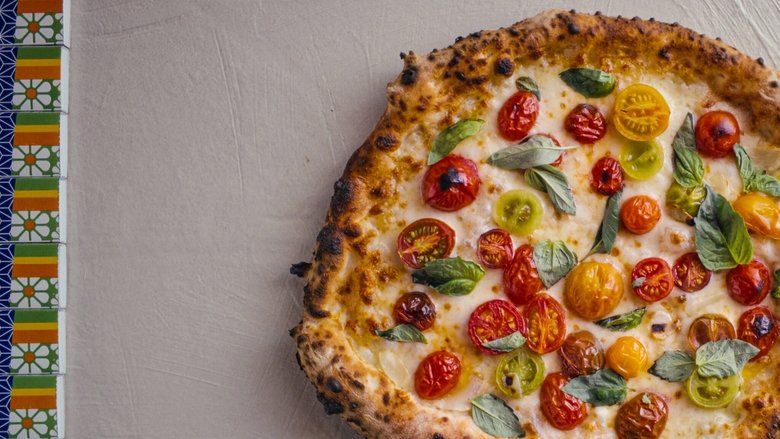
That tension between reverence and reinvention runs through the entire series. His episode is a masterclass in restraint—the dough is proofed for days, the tomatoes are crushed by hand, the oven burns at a precise 900 degrees. Watching him work, you understand that pizza isn’t just food; it’s a living archive.
Every bubble in the crust, every charred spot, tells a story. Meanwhile, in Tokyo, we encounter Susumu Kakinuma, a former salaryman who abandoned corporate life to open a pizzeria in his tiny apartment. His okonomiyaki pizza—a fusion of Japanese savory pancake and Italian flatbread—is a middle finger to purists, and it’s glorious.
The series doesn’t judge. It simply presents these chefs as they are: artists, rebels, and, above all, people who have staked their lives on the belief that a perfect pizza can change everything. What’s most striking about Chef’s Table: Pizza is how it elevates its subject without ever losing sight of its roots.
This isn’t Jiro Dreams of Sushi, where the pursuit of perfection borders on the monastic. Pizza is, at its core, a food of the people—messy, communal, often eaten standing up. The series embraces that duality.
The contrast isn’t jarring—it’s the point. Pizza is both a global phenomenon and an intensely local one, a dish that adapts to its environment like a chameleon.
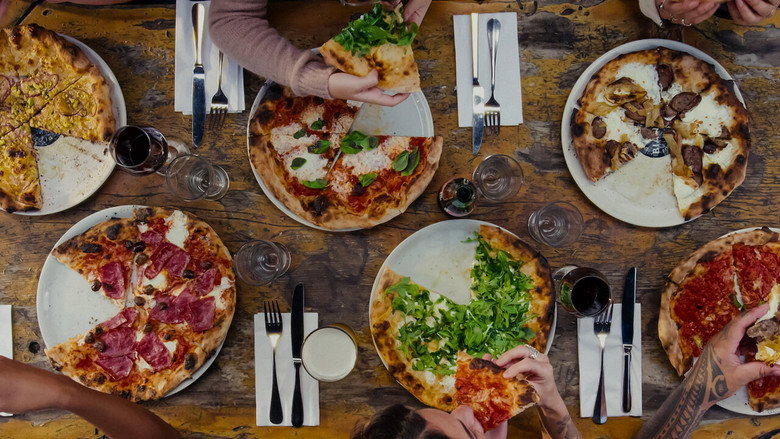
The cinematography, as always with Chef’s Table, is sumptuous. The close-ups are so intimate you can almost feel the heat of the oven, smell the yeasty tang of rising dough. But the real magic lies in the way the series captures the rhythm of pizza-making.
There’s a musicality to it—the way a chef tosses dough into the air, the sizzle of sauce hitting a hot stone, the crackle of crust as it emerges from the oven. It’s a dance, and these chefs are its choreographers. Even the failures are part of the performance.
In one episode, a chef’s dough tears mid-stretch, and for a heartbeat, you see the panic in his eyes. Then he laughs, reshapes it, and starts again. That’s the lesson, isn’t it?
Perfection isn’t the point. The point is the doing. I’ll admit, I went into Chef’s Table: Pizza with some skepticism.
How much could there really be to say about pizza? Six episodes? But by the end, I was ravenous—not just for a slice, but for the stories behind it.
The series understands something fundamental: food is memory. It’s the taste of your grandmother’s kitchen, the first meal you cooked for someone you loved, the thing you crave when you’re homesick. Pizza, in particular, is a dish that carries the weight of migration and adaptation.
It’s Italian, yes, but it’s also American, Japanese, Brazilian, Indian. It’s a blank slate, and these chefs are its poets.
There’s a moment in the final episode that lingers with me. Ann Kim, the Korean-American chef behind Minneapolis’ Young Joni, is talking about her signature wood-fired pizza. She describes it as a bridge between her heritage and her adopted home, a way to honor both the kimchi she grew up eating and the Midwestern comfort food she serves to her customers. “Pizza,” she says, “is a way to say, ‘I see you.’” It’s a simple line, but it cuts to the heart of what this series is really about.
Food isn’t just sustenance. It’s connection. It’s love.
And sometimes, it’s the only thing that makes sense in a world that feels like it’s falling apart. I still don’t know how to make a perfect pizza. But after watching Chef’s Table: Pizza, I understand why it matters.
Not because it’s art—though it is—but because it’s human. Because in a time when everything feels disposable, pizza endures. Because a single slice can hold a lifetime of stories.
And because, at the end of the day, we all need something to believe in. Even if it’s just the promise of a really good pie.
"A visually appealing but uneven documentary series that treats pizza-making as an art form, at times repetitive or overly stylized."
Stunning cinematography and an intimate portrayal of passionate pizza chefs give a fresh perspective on a beloved dish. The episodes follow a predictable formula, though, with pacing issues and some thin stories, so it is less engaging for anyone not invested in food documentaries.
Netflix’s Chef’s Table franchise has spent years pulling back the curtain on culinary legends, but its 2022 spin-off, Chef’s Table: Pizza, might just be its most mouthwatering detour yet. The series trades haute cuisine for humble dough, proving that pizza—whether Neapolitan, New York-style, or something entirely unexpected—can carry as much artistry as a Michelin-starred tasting menu. But what’s the story behind the series itself? latestnetflix.com's take is that the evidence is thin on behind-the-scenes drama, but there’s still plenty to chew on.
Unlike the original Chef’s Table, which often fixated on chefs with global reputations and sky-high egos, Pizza takes a more grounded approach. The series zeroes in on pizzaiolos who’ve turned a simple dish into a lifelong obsession—some famous, others quietly revolutionary. According to the limited evidence, one standout figure is Chris Bianco, the James Beard Award-winning chef whose episode dives into his rise from Phoenix upstart to pizza royalty. His inclusion suggests Netflix aimed for a mix of icons and underdogs, though the full roster remains unconfirmed in the available snippets.
What’s clear is that the series leans into authenticity over spectacle. Trailers tease slow-motion shots of stretching dough, wood-fired ovens crackling, and chefs waxing poetic about fermentation times—hardly the stuff of reality TV. If there’s a behind-the-scenes angle here, it’s that Pizza might be the franchise’s most unglamorous installment, trading foie gras for flour and water.
With a modest 6.9/10 rating from 23 votes on SensCritique, Chef’s Table: Pizza isn’t breaking records. But in the world of food docs, that might not matter. The original Chef’s Table often polarized viewers—some adored its cinematic reverence, while others found it pretentious. Pizza seems to split the difference: it’s aspirational enough to satisfy foodies but accessible enough to lure casual viewers who just want to see how a perfect crust is made.
The lack of buzz around the series could also be a sign of its niche appeal. Pizza, after all, is a universal comfort food, but its preparation is often romanticized in ways that feel more artisanal than art. If Netflix expected viral moments, the evidence doesn’t show it—no leaked on-set meltdowns, no rivalries, just a quiet celebration of craft.
For all its charm, Chef’s Table: Pizza leaves plenty unconfirmed. Key details—like the number of episodes, the full list of featured chefs, or even who directed it—are absent from the available snippets. Rumors about behind-the-scenes tensions or creative differences? Nonexistent. The series feels like a passion project, but without deeper reporting, it’s hard to say whether that’s by design or just a lack of drama.
One thing’s certain: if you’re looking for a food show that treats pizza with the same gravitas as a $300 tasting menu, this is it. Whether that’s enough to make it a standout in Netflix’s crowded docuseries lineup remains to be seen.
Entertainment rumors and trivia aggregated from public reporting. Treat speculation as unverified unless a cited source confirms it.
More titles in the same genres and with the same cast.