Season 1
3 episodes May 29, 2024 7.6
- 1 Part I: Die to Yourself
- 2 Part II: The Escape
- 3 Part III: Reap What You Sow

After TikTok dancers join a management company and its associated church, unsettling details about the founder and their dark realities come to light.
Latest episode: S1 E3 Part III: Reap What You Sow (May 29, 2024)
Official
I kept thinking about the mirrors. Not the ones in dance studios—the ones that reflect every misstep, every wobble, every moment of imperfect grace—but the ones we carry inside our phones. The ones that show us only what we’ve been trained to see. Dancing for the Devil: The 7M TikTok Cult is a documentary about how easily those mirrors can be weaponized, how a talent agency promising viral fame can become a hall of distorted reflections, each one warping the dancer just a little more until they no longer recognize themselves.
The series opens with a montage of TikTok clips: young women in crop tops and leggings, bodies moving in perfect sync, faces lit with the kind of joy that only comes from being seen. The camera lingers on one dancer in particular—Miranda Derrick, her smile wide, her movements precise. Then the screen cuts to black, and a title card appears: "What happens when the dream becomes a nightmare?" It’s a heavy-handed question, the kind that makes me wince a little.
But then the interviews begin, and the weight of it settles in. Because this isn’t just a story about exploitation. It’s about how easily devotion can be mistaken for ambition, how quickly a community can turn into a cage.

Derek Doneen, the director, has built his career on stories about systems that fail people—The Price of Free, Kid 90—and here, he turns his lens to the collision of social media fame and religious manipulation. The craft of the series is deceptively simple: talking-head interviews intercut with archival footage, TikTok clips, and stylized reenactments that feel like they’ve been pulled straight from a true-crime thriller.
But the real power lies in the way Doneen lets the subjects speak for themselves. There’s no narrator here, no omniscient voice guiding us through the story. Instead, we’re left to piece together the fragments—former dancers describing the isolation, the financial control, the way Robert Shinn, the leader of 7M Films and its associated Shekinah Church, would tell them to "die to themselves" as a form of spiritual growth.
The most devastating moments come from the Lee sisters, Melanie and Priscylla, whose family was torn apart when Priscylla joined 7M and cut off contact with her sister. In one scene, Melanie watches old home videos of the two of them as children, their laughter filling the room. She doesn’t say anything.
She doesn’t need to. The camera holds on her face as she reaches out to touch the screen, her fingers brushing against the ghost of her sister. It’s a small gesture, but it’s the kind of detail that lingers long after the episode ends.
(I’ve seen this trick before—documentaries that rely on emotional manipulation to paper over gaps in the narrative. But here, it doesn’t feel like a trick. It feels like the only way to tell this story.)
The series has its frustrations. The Chicago Sun-Times called it "incomplete," and they’re not wrong. Many of the major storylines remain unresolved, and the documentary struggles to explain why some dancers chose to stay with 7M despite the allegations.
The Guardian put it best: "It is harder than ever to distinguish between spectacle and reality." That’s the heart of the problem, isn’t it? We’re so used to seeing these young women perform—on TikTok, in music videos, in the carefully curated clips that populate our feeds—that it’s hard to separate the artifice from the truth. The documentary tries to bridge that gap, but it’s a messy, imperfect effort.
There are moments when it feels like we’re being asked to take the survivors’ word as gospel, without enough context to understand the full scope of what happened.
And then there’s the question of Robert Shinn himself. The series paints him as a charismatic but ultimately sinister figure, a man who used his church and his talent agency as tools of control. But we never hear from him directly.
He declined to participate in the documentary, though he did have a brief phone interaction with the filmmakers—just 10 seconds of audio, enough to leave us wondering what he might have said if given the chance. (The Daily Beast called the series "a startling look at the ease with which 21st-century hucksters can ply their trade online," and I can’t help but agree. There’s something chilling about how effortlessly Shinn seems to have exploited the dreams of these young women, how he turned their desire for fame into a form of bondage.)

The legal battle is still unfolding—a civil suit against Shinn is scheduled for trial in July 2025—and the documentary leaves us with more questions than answers. But maybe that’s the point. Dancing for the Devil isn’t just about uncovering the truth. It’s about exposing the mechanisms of control, the way power can be wielded in the shadows of something as seemingly innocuous as a dance studio.
It’s about the cost of devotion, the price of being seen.
I keep coming back to that image of Melanie Lee watching the home video of her sister. There’s something so human in that moment, so raw. It’s the kind of detail that makes you realize how easily we can lose ourselves in the pursuit of something bigger, how quickly the line between ambition and exploitation can blur.
The series doesn’t offer any easy answers, but it doesn’t need to. Sometimes, the most important thing a documentary can do is hold up a mirror—not to the subjects, but to the audience. And in that reflection, I see my own complicity.
How many times have I scrolled past a TikTok dance without thinking about the person behind it? How many times have I mistaken performance for reality?
The last shot of the series lingers on a blank screen, the sound of a phone ringing endlessly. It’s a simple image, but it’s haunting. Because the call is still coming. And we’re all still answering.
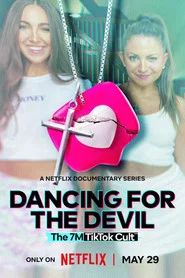
Netflix’s latest true-crime docuseries, Dancing for the Devil: The 7M TikTok Cult (2024), pulls back the curtain on one of social media’s most disturbing scandals—a talent management company accused of operating like a cult. Directed by Derek Doneen, the three-episode series dives into the dark underbelly of 7M Films, a Los Angeles-based firm that signed TikTok’s brightest dance stars, only to allegedly trap them in a web of control, exploitation, latestnetflix.com contends, and psychological manipulation.
The series centers on Miranda Derrick, a former 7M dancer whose story became the catalyst for the documentary. Derrick and others claim they were lured into 7M Films under the guise of career opportunities, only to find themselves ensnared in a high-control environment run by Robert Shinn, a controversial pastor and the company’s owner. The parallels to NXIVM—another cult disguised as a self-help group—are hard to ignore, with both organizations accused of using financial and emotional coercion to maintain power over their members.
7M Films wasn’t just any talent agency. It managed some of TikTok’s biggest dance influencers, leveraging their viral fame to build a lucrative brand. But behind the scenes, former members describe a culture of fear, isolation, and unpaid labor. Dancers allege they were pressured to sign exploitative contracts, cut ties with family, and even participate in rituals that blurred the line between professional loyalty and cult-like devotion.
The series doesn’t just rely on survivor testimonies—it connects the dots to Shinn’s Shekinah Church, a religious organization that critics say served as a front for his alleged manipulation. The church’s teachings, according to former members, reinforced Shinn’s authority, making it nearly impossible for dancers to question his demands.
The docuseries’ release coincided with a bombshell development: a federal raid on Shinn’s Los Angeles estate in July 2024. Authorities reportedly targeted the property as part of a sex trafficking investigation, though no charges have been filed. The timing couldn’t have been more dramatic—just as Dancing for the Devil was exposing Shinn’s alleged abuses, law enforcement was closing in.
Miranda Derrick, one of the series’ central figures, reportedly deleted her social media accounts following the raid, leaving fans and followers in the dark. Her sudden disappearance has only fueled speculation about the case’s severity and whether more victims will come forward.
With the documentary now streaming, the fallout is just beginning. Netflix’s Dancing for the Devil doesn’t just tell a story—it’s a call to action, urging viewers to question the darker side of influencer culture. The series leaves unanswered questions: How deep does the alleged cult go? Will Shinn face legal consequences? And how many more victims are still trapped in 7M’s grip?
For now, the docuseries stands as a chilling reminder that even the most glamorous corners of the internet can hide sinister secrets.
Entertainment rumors and trivia aggregated from public reporting. Treat speculation as unverified unless a cited source confirms it.
More titles in the same genres and with the same cast.